


Dating apps face a clear retention challenge. According to a dating app industry report published in 2026, the dating app retention rate in 2025 was 26% on Day 1, 12% on Day 7, and 6% on Day 30.
But low retention does not always mean users had a poor experience. Some leave because they could not find the connections they wanted. Others stop using the app because they found a partner. Each calls for a different response, so the reason matters before you decide how to improve retention.
This blog covers the Day 1, Day 7, and Day 30 benchmarks, explains how to interpret your own dating app retention rate, and identifies the parts of the user journey worth examining first.
Key Takeaways
- Dating app retention improved in 2025, reaching 26% on Day 1, 12% on Day 7, and 6% on Day 30.
- Low retention does not always indicate a poor user experience. Users may leave because of frustration, fatigue, safety concerns, a temporary break, or finding a relationship.
- Retention analysis should connect acquisition source, user expectations, in-app experience, and payment behavior.
- Teams should identify where users drop off: before matching, after matching, during conversations, or after encountering payment and safety concerns.
- Effective retention strategies include improving match relevance, helping users start meaningful conversations, supporting healthy breaks, and respecting users who leave after finding a relationship.
- Day 30 retention is a checkpoint metric, not proof that all other users have permanently churned. Always compare metrics with the same definitions and measurement windows.
Dating App Retention Benchmarks: Day 1, Day 7, and Day 30
According to Adjust’s dating app retention benchmarks, dating app retention reached 26% on Day 1, 12% on Day 7, and 6% on Day 30 in 2025.
| Data year | Day 1 | Day 7 | Day 30 |
| 2024 | 24% | 11% | 5% |
| 2025 | 26% | 12% | 6% |
Day 1 retention rose by 2 percentage points, while Day 7 and Day 30 each gained 1 percentage point, showing improvements in dating app return rates from the day after installation through the one-month mark. Even so, D30 retention remained in single digits, highlighting the challenge of sustaining engagement over time.
When evaluating your dating app, look beyond whether the initial experience brings users back: check whether those gains also extend to D7 and D30. Use these benchmarks as a reference, but consider your audience and why users leave when assessing your retention performance.
Why Do Dating App Users Stop Returning?
Users of dating apps may stop returning either because they failed to find the connection they expected or because they have already found a partner. Therefore, similar declines in retention can correspond to completely different user outcomes. Before selecting retention strategies, the team needs to first figure out whether users left out of disappointment, are taking a break, or have entered a relationship.
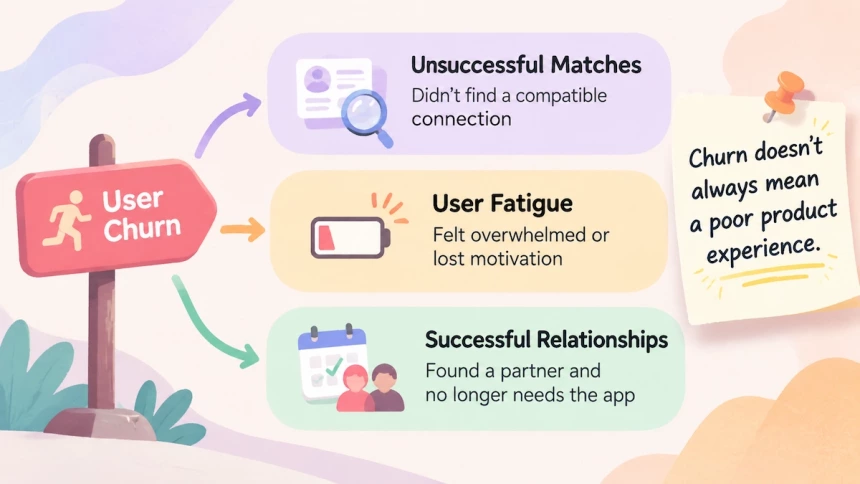
Matches Do Not Always Lead to Meaningful Connections
Users can receive messages every day and still lose motivation to return. For someone seeking a relationship, conversations become meaningful when they help assess compatibility or bring both people closer to meeting. Repeated introductions with little progress can make the process feel like work.
One Reddit user described spending days maintaining conversations without exchanging phone numbers or arranging dates. She eventually felt exhausted. Her experience highlights something message counts cannot capture: users may stay active without feeling that their efforts are going anywhere.
Progress does not always mean arranging a date. Discovering that two people want different things can also help users decide whether to continue. The problem arises when conversations reveal little about compatibility, leaving users unsure whether a connection is worth pursuing.
More conversations can also create pressure. According to Pew Research Center’s 2023 U.S. report, 36% of people who had used dating sites or apps in the previous year had at least sometimes felt overwhelmed by message volume. Managing several conversations takes time and attention. Users must keep up with replies and remember details, even when few exchanges seem promising. Eventually, the effort may outweigh the value they get from the app.
To investigate this type of churn, look at users who matched and chatted regularly but eventually stopped returning. Were their matches poorly aligned with their relationship goals? Did conversations remain superficial? Or did managing multiple chats become exhausting? These patterns point to different sources of frustration. The issue may not be a lack of interaction, but a lack of meaningful progress.
Fatigue, Paywalls, and Negative Experiences
Repeatedly browsing profiles, introducing yourself, and maintaining conversations that go nowhere can make dating feel like work. When users stop looking forward to the next interaction, stepping away can feel like the only way to get a break. In a 12-week study on dating app burnout, researchers observed increasing emotional exhaustion and feelings of inefficacy among participating dating app users. These psychological changes, however, do not establish whether users uninstalled the app or left permanently.
Emotional fatigue is only one reason users may pull back. Frustration with paywalls can create doubts about the app’s value much earlier. Users who encounter like limits or paid features before having a worthwhile exchange may feel they are being asked to spend more before knowing whether the app is useful. Their desire to leave may therefore stem from uncertainty about value, rather than price alone.
For some users, the concern is more fundamental: whether the app feels safe to use. Harassment, suspected scams, and continued contact after rejection can shift attention away from meeting potential partners and toward assessing risks and managing unwanted interactions. When that burden outweighs their willingness to keep trying, they may take a break or leave altogether.
The Retention Paradox: Success Can Also Drive Churn
For users seeking a committed relationship, finding a partner can remove the need to keep browsing and matching. An app may achieve its purpose while losing its place in someone’s daily routine.
Research on why people stop using dating apps reflects this shift. A study on why users leave dating apps surveyed 349 Portuguese users who had previously discontinued use. Some respondents identified starting a relationship as one of their reasons for stopping. As attention shifts toward a partner, searching for other people may no longer serve the user’s needs.
For subscription-based dating apps, this creates a potential tension: helping users find partners sooner may shorten their usage and payment cycles. In its 2021 IPO prospectus, Bumble listed users forming meaningful relationships and no longer needing its products as a factor that could reduce retention. This is an acknowledged business risk, not evidence that platforms deliberately delay successful matches.
High retention does not necessarily indicate relationship progress, and low retention does not necessarily indicate product failure. Users may leave because their search has produced no results—or because it has already succeeded.
How to Improve Dating App Retention
Improving retention requires a clear understanding of why users leave and what encourages them to return. Effective strategies for how to increase app retention rate should account for different user needs and behaviors throughout the app journey.
AsoHot’s Insight: Retention Starts Before Installation
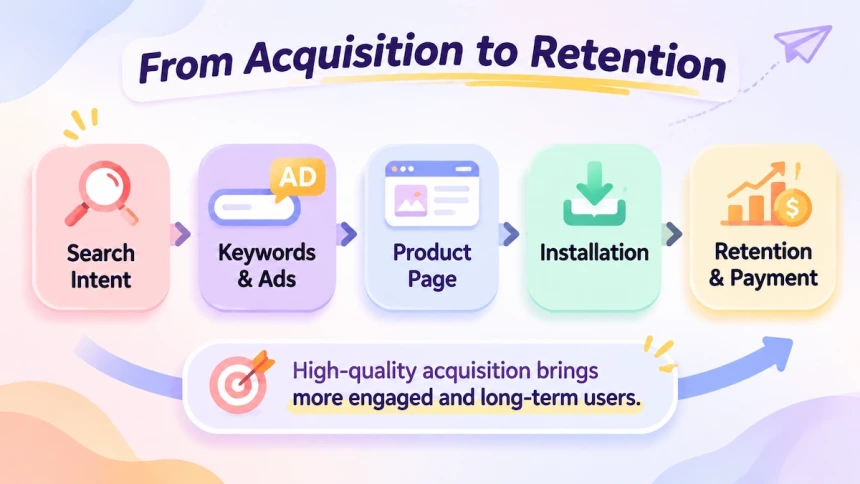
AsoHot’s work with LesPark, a social and dating app for LGBTQ+ women, shows how acquisition efforts can support better retention analysis. LesPark serves a niche LGBTQ+ audience. To reach users with different needs, AsoHot grouped keywords by search intent and matched each group with relevant screenshots, app descriptions, and custom product pages.
This approach allowed the team to assess user quality beyond acquisition efficiency, bringing retention and payment behavior into the evaluation of its mobile app marketing strategy. The team could compare these outcomes across search-intent groups, while the account achieved an overall ROI of 100% over the full project period.
Based on this experience, AsoHot believes that acquisition performance should be measured by more than cost per install.
Teams should compare Day 1, Day 7, and Day 30 retention, along with payment behavior, across different search-intent groups. When one group shows weaker results, teams should examine whether the in-app experience matches the expectations set by the acquisition message.
In AsoHot’s view, retention analysis starts before a user opens the app, with the expectations created by the keywords, ads, and product page that lead them to install.
Help Users Move Beyond the Match
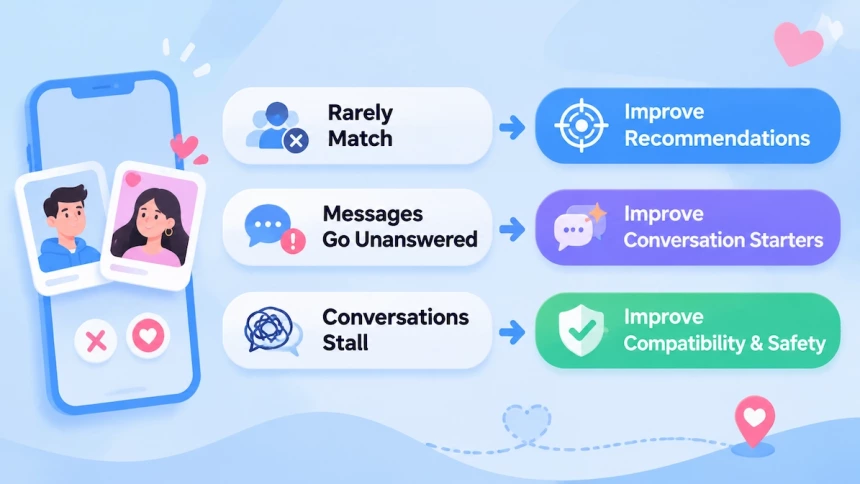
Start by separating users who rarely match, those whose messages go unanswered, and those whose conversations stall. They may all stop returning, but each group needs a different response.
- If users rarely match, check who they have a chance to meet. Review the available profiles within their location and preferences, and whether recommendations reflect their dating intentions. A user looking for a relationship may have plenty of profiles to browse but few people seeking the same thing. If relevant profiles are available but poorly surfaced, test recommendation changes. If local availability is limited, explain that clearly and let users choose whether to broaden their search.
- If messages go unanswered, check both the recipients and the effort of starting a conversation. Are users contacting active accounts? Do profiles offer anything specific to ask about? Where users struggle with an opening, test optional prompts drawn from shared interests or profile details. A mention of weekend hiking, for example, gives someone more to work with than an empty bio. Keep suggestions editable so messages still sound like the person sending them.
- If conversations stall, ask what made users lose interest. Repeated small talk, incompatible goals, and unwanted messages require different changes. Test ways to surface interests and intentions earlier when users lack information. For harassment or suspicious behavior, prioritize accessible blocking, reporting, and clear support follow-up.
Once you have identified where conversations break down, a small test can help you decide whether the proposed change is worth rolling out.
For users who match but struggle to start talking, show a profile-based opening suggestion to a randomly selected group and keep the existing chat screen for the other. Let users edit or ignore the suggestion. Over the same test period, compare how often matches lead to a first message and how often those messages receive a reply within a fixed window. If the prompt gets more people to write but the reply rate does not improve, check recipient activity and match relevance before expanding it.
Make Pausing and Returning Easier
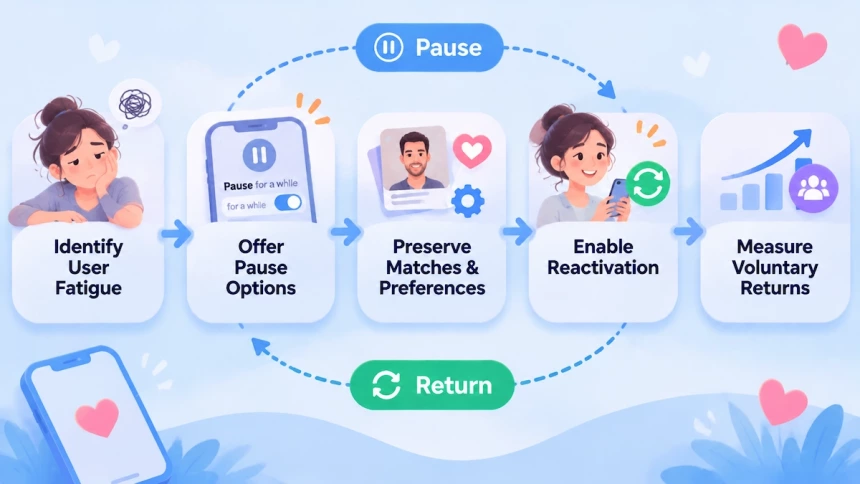
For users worn out by stalled conversations, taking a break may be more helpful than another reminder to open the app. Before introducing a pause feature, talk to recent leavers. Were they tired of conversations that led nowhere, or had they encountered harassment or a poor payment experience? Some users may need time away; others need the underlying problems addressed before considering a return.
If users need a break, give them a simple way to pause without losing their profiles, matches, or preferences. Explain what happens during the pause:
- Can existing matches still send messages?
- Which notifications will stop?
- Will their profile be hidden from new users?
- Can they choose whether and when to receive a return reminder?
Making it easy to return is only part of the process. Before reactivating, let users review their profile visibility and preferences. If interviews reveal that managing too many conversations caused fatigue, test options to mute or archive chats. Returning users can then choose which conversations to pick up again.
To assess whether the feature helps, look beyond reactivation counts:
- Voluntary returns: What share of paused users return within 30 days without receiving a reminder?
- Activity after returning: Among those who return, what share open the app again between days 7 and 30 after reactivation?
- User feedback: Do returning users say the experience feels easier to manage, and what still causes frustration?
If users return briefly and report the same frustrations, the underlying problems may still need attention. An easier return cannot make up for an experience they still find exhausting.
Let Users Leave Gracefully After Finding a Relationship
When users leave because they found a relationship, let them leave without pressure or default win-back messages. Hinge’s data lead calls this good churn: leaving can reflect a successful experience.
What to do
- Respect the exit. Stop re-engagement messages once users report finding a relationship. Make pausing or deleting their account straightforward, without retention offers. Keep only necessary account and service notices.
- Record the reason separately. Add “Found a relationship” as an exit reason and exclude these accounts from default win-back campaigns. Keep them in overall churn reporting, with a separate breakdown.
- Keep feedback optional. Ask once whether they would recommend the app and how long finding the relationship took, using a consistent time definition. Make both questions skippable. If measuring relationships formed through the app, also ask whether they met there.
- Make story sharing optional. Invite couples who met through the app to share their story on your app, website, or official social media accounts. Obtain both partners’ consent to the content and publishing channels before posting.
A good exit leaves users feeling respected—and comfortable recommending the app to someone who still needs it.
Looking Beyond the Retention Rate
Industry benchmarks help teams see where their dating app stands. Users’ experiences explain what those numbers mean. Improving retention means addressing the frustrations that make people give up while they still want to meet someone, and recognizing when leaving reflects a relationship found. Start with the obstacles your users face, and make their next interaction worth coming back for. When they no longer need the app, let them leave knowing their time there was well spent.
FAQs
Is Day 30 Retention the Same as Monthly Retention?
No. Day 30 retention measures returns at a specific checkpoint after installation. Monthly retention may use calendar months or broader windows, so check the definition before comparing.
Does Low Retention Mean a Dating App Is Failing?
Not necessarily. Users may leave because of frustration, a temporary break, or finding a relationship. Retention alone cannot distinguish these outcomes.
Does 6% Day 30 Retention Mean the Other 94% Have Stopped Using the App?
Not necessarily. If the metric measures returns on Day 30 only, users who return on other days would not count. It does not mean everyone else has permanently left.
Can Retention Rates from Different Reports Be Compared?
Only when their methods and samples are comparable. Check the starting event, return event, measurement window, audience, and data period before drawing conclusions.