

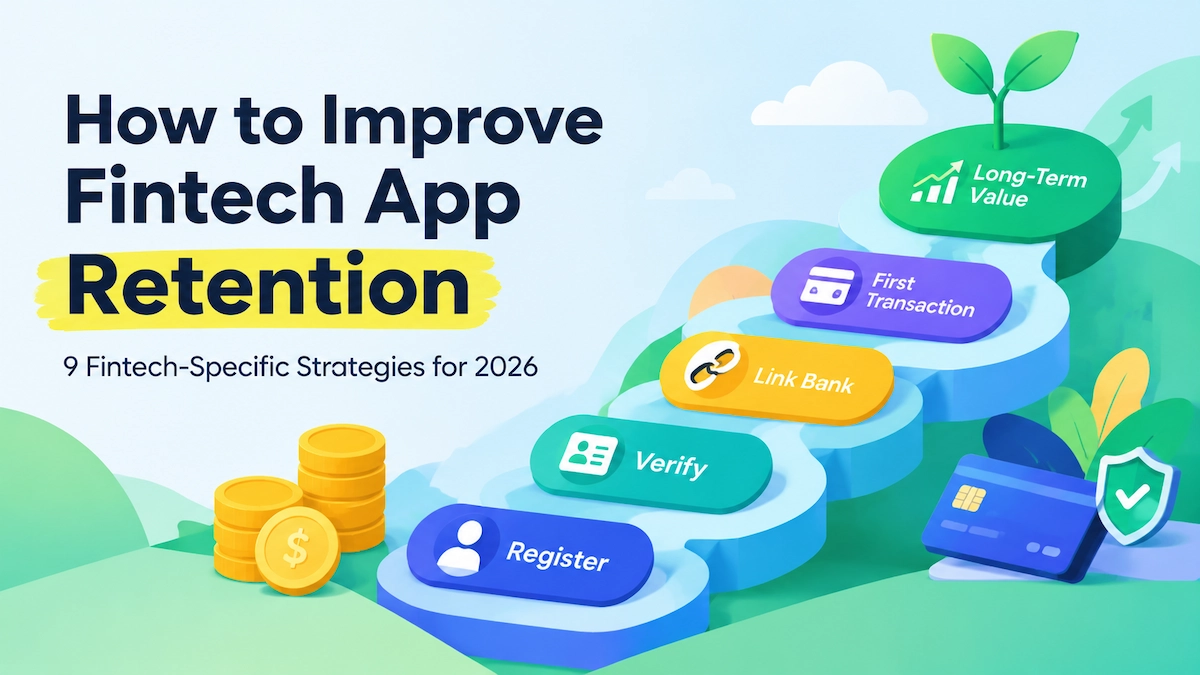
Acquiring a fintech customer is expensive, but losing one takes a single tap. Switching costs are low, so every install only pays off if the user stays long enough to cover what it cost to win them. That is why efforts to improve your fintech app retention rate, more than acquisition alone, determine customer lifetime value (LTV).
Fintech apps face a harder version of this challenge. Before a new user sees any value, they have to register, verify their identity, link a bank account, and fund it, and a risk check can turn them away at any point. Even after all that, the app still has to compete to become the place where their money actually moves.
This guide covers nine strategies for improving fintech app retention, from verification and first funding to everyday use, trust, and re-engagement. A 30-60-90 day plan then shows how to put them into action.
Key Takeaways
- To improve fintech app retention rate, fix the path to the first transaction. Users stall at verification and funding, so make both steps easy.
- Become the primary app. Link the app to salary deposits, bill payments, and savings routines, and let alerts, recommendations, and rewards support those habits.
- Make trust part of the product. Be upfront about fees, show accurate balances, and help users recover quickly from failed payments and account holds.
- Track financial behavior, not just logins. Changes in payments, deposits, and balances show who is drifting away and who is worth winning back.
- Share ownership across teams. Product, lifecycle, risk, compliance, and support each own part of retention, and the 30-60-90 day plan spells out who does what.
Why Fintech Retention Is Different
In fintech, users have to register, verify their identity, link a bank account, and make a first transaction before they see any value. A stumble at any step can end the relationship early.
The Activation Ladder
That long path makes drop-off the first thing to measure:
| Stage | Typical drop-off cause |
| Install → Register | Unclear value, lengthy forms |
| Register → Pass KYC(Know Your Customer) | Unclear requirements, failed checks, review delays |
| Pass KYC → First funding or transaction | Account-linking and funding friction |
| First → Repeat transaction | Weak ongoing value, poor experience |
Not every exit means lost interest: compliance reviews and banking partners can also stall an account.
What Sets Fintech Apart
Keeping users is also harder in fintech:
- Trust is fragile: Hidden fees, failed payments, or a security scare can send users elsewhere.
- Acquisition is expensive, while switching costs are low: Users can leave for another service with little effort.
- Many users have several financial apps but rely on only one: Becoming their primary app for everyday transactions can support long-term retention.
How to Improve Fintech App Retention Rate: 9 Strategies
General app retention strategies cover messaging frequency, user segmentation, and testing. Fintech apps also need to address verification drop-offs, first transactions, and the trust required to keep users engaged with financial services.
1. Simplify KYC by Verification Status and Recover Abandoned Verifications
KYC verification can become a major drop-off point when users do not understand the requirements, encounter failed checks, or have to wait for approval. A single follow-up message cannot address all these problems because users may be stuck at different stages.
Group users by verification status: not started, in progress, under review, rejected, or additional information required. For users who have not started, explain why verification is needed and what documents they should prepare. For users who abandon the process midway, clarify the remaining steps and help them resume where possible. For pending applications, show the current status and expected review time when available. If an application is rejected or more information is needed, explain the next steps and offer a retry or resubmission path where permitted.
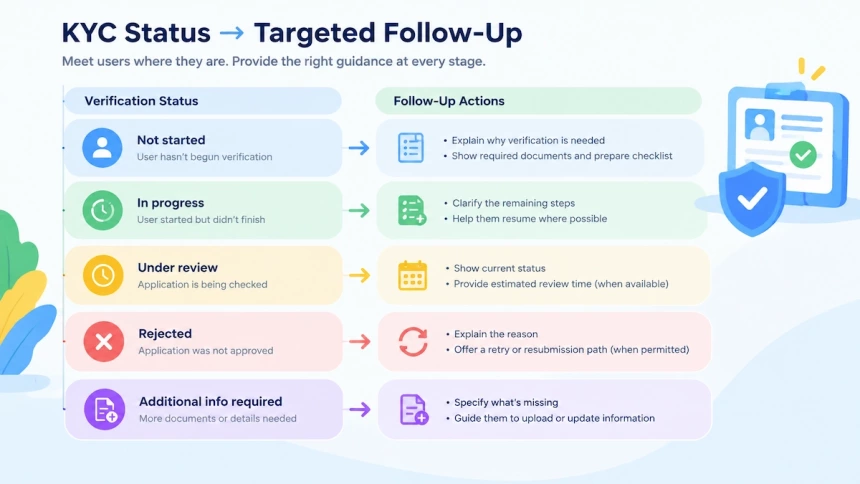
Track KYC completion rates, drop-off rates at each stage, and the share of users who complete verification after being asked for additional information. Keep all legally required checks in place. For apps without KYC requirements, apply the same approach to registration or account linking.
2. Reduce Funding Friction and Design the First Transaction
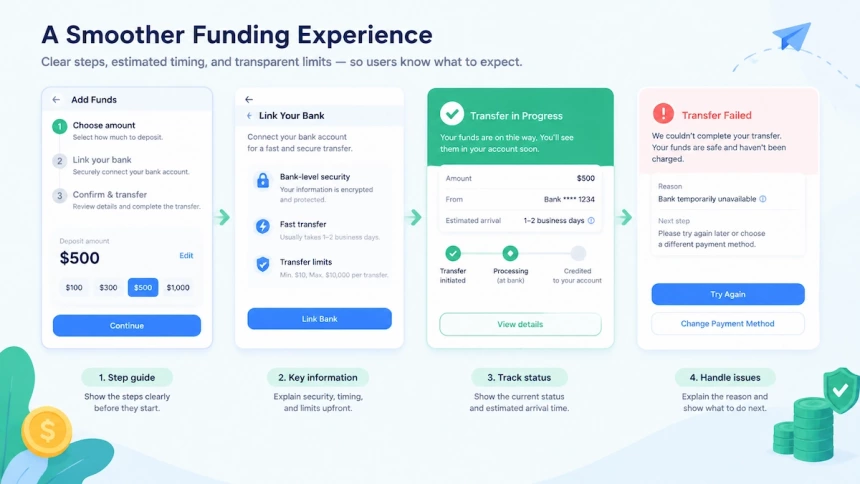
The first time someone funds a fintech app can make or break the relationship. Bank linking fails. Verification takes a while. Deposit limits and processing delays can leave users unsure when their funds will be available.
The fix is simple: tell users before they hit the button. A good funding flow walks people through the steps, states how long the transfer will take, and is upfront about any limits. When a transfer is delayed or fails, users shouldn’t be left guessing — the app shows the current status and explains what to do next.
Getting money in the door is only half the job. Once it lands, point users toward something meaningful. What that looks like depends on the app’s core purpose: sending a first payment, checking a balance, or setting up an automatic savings rule. For apps with a social side, a transaction activity feed is a great way to show how things work without a long tutorial.
The funding flow isn’t the only place to nudge users. A quick in-app welcome message sets expectations at sign-up. A relevant email within 24 hours then reminds users why they joined and points them to the next step.
How to tell if it’s working? Three numbers are worth tracking:
Funding conversion rate = Users who fund their account within [X] days of signing up ÷ Users who sign up × 100%
Time to first funding (median recommended) = First funding time − Registration time
Seven-day repeat rate = Users who make a second transaction within 7 days of their first ÷ Users who made a first transaction (at least 7 days ago) × 100%
For apps that don’t require funding, the focus shifts to whether users complete their first meaningful transaction or try a key feature.
3. Connect Everyday Money Flows
Make the app part of users’ everyday financial routines. For account-based products, features such as salary deposits, automatic savings, and recurring bill payments give users practical reasons to keep using the same account. Once established, these routines also make switching less convenient, because users would need to move their existing financial arrangements.
Getting users there takes guidance. A setup checklist can walk users through switching their salary deposits and bills, making the transition easier to manage. Once the routines are in place, use a simple habit loop to keep them alive. A trigger prompts an action, and a meaningful reward gives users a reason to return. For example, a savings reminder can lead users to review their progress toward a financial goal. The key metrics here are primary-account rate, recurring deposit rate, and the number of linked recurring payments.
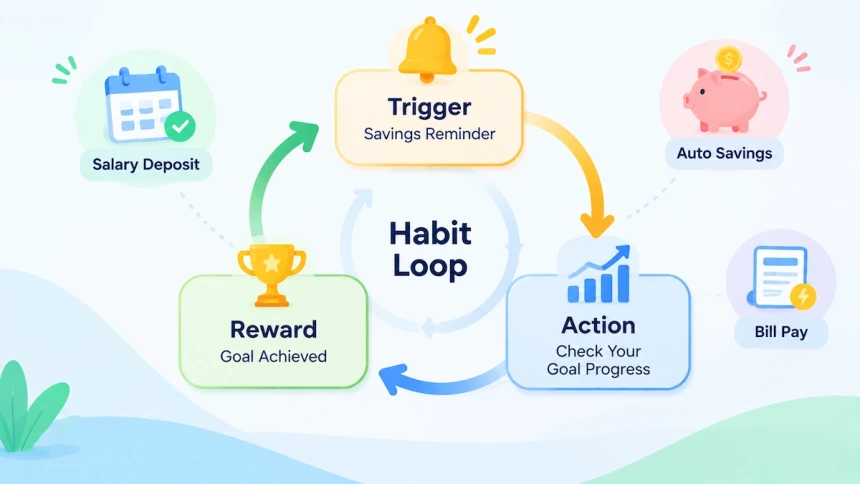
Not every app moves money this way. For investment and budgeting apps, the same logic applies to core features instead. Users have an ongoing reason to revisit portfolio monitoring, transaction tracking, and budget updates. These features become the everyday touchpoints that keep the app in their routine.
4. Separate Service Alerts From Marketing Messages
Fintech apps can use notifications for two different purposes: keeping users informed about their finances and encouraging them to explore relevant features. Service alerts cover important events such as bill due dates, failed payments, and unusual transactions. Payday can also trigger timely messages, such as a salary deposit confirmation or a reminder to move money into savings.
Marketing messages can go beyond transaction updates to highlight features that match users’ financial habits. For example, a budgeting app could show users how much they saved that month: “You saved $X this month.” Personalized messages like this can make the app’s value more tangible, provided the figures are based on accurate data.
These messages should also follow different sending rules. Define separate consent and compliance requirements for service alerts and marketing messages based on the message type, channel, and applicable regulations. Apple’s App Store Review Guidelines, for example, treat marketing pushes differently. Promotional push notifications are allowed only if users have explicitly opted in through consent language in the app and can opt out.
5. Expand Product Adoption Through Personalized Recommendations
Once users are comfortable with a fintech app’s core service, introduce other products or features that address their financial needs. Use their transaction history, spending patterns, and stated goals to identify relevant opportunities, such as a suitable credit card, loan, savings account, or investment feature.
Personalization should extend beyond product recommendations. A tailored dashboard can highlight the information and tools most relevant to each user. For example, users focused on budgeting may benefit from spending insights, while regular savers may find savings progress and goal-based recommendations more useful.
The key is to build a gradual product journey rather than promote multiple products at once. Introduce additional services when users have demonstrated a relevant need, and explain their benefits, fees, and eligibility requirements clearly. For credit products in particular, recommendations should account for user eligibility and applicable lending regulations. More product adoption does not automatically mean better retention; each recommendation should provide genuine value.
Track the second-product adoption rate and the 90-day retention rate of users after adoption. These metrics help determine whether cross-product recommendations are attracting sustained engagement rather than simply increasing initial conversions.
6. Design Rewards That Encourage Lasting Engagement
Cashback, loyalty points, interest-rate boosts, and early access can encourage continued product use. Referral bonuses, such as Venmo’s, help attract new users, while paid memberships like Robinhood Gold offer additional benefits.
These incentives should bring lasting value to both users and the business. Reward costs need to be weighed against the long-term value of acquired users to avoid attracting people who leave once bonuses expire.
Gamification offers another way to encourage engagement. Savings streaks and achievement badges can reinforce positive financial habits. For investment and trading apps, these features require particular care. In an FCA experiment, points and prize draws increased trading frequency by 12% and raised the share of trades made in high-risk investments by 6%. Rewards should support healthy financial habits rather than encourage unnecessary transactions.
Measure their effectiveness through post-reward retention at 30 and 60 days, cost per rewarded user, and retention comparisons between reward-driven and organic users.
7. Make Security, Fees, and Money Data Transparent and Accurate
Users need to trust that their money and personal data are safe. Make fees, account terms, and product benefits clear before users make financial decisions. Display balances and transaction statuses accurately, distinguishing between pending and posted payments so users know which funds are available. Avoid hidden charges or unclear descriptions that could lead to unexpected surprises.
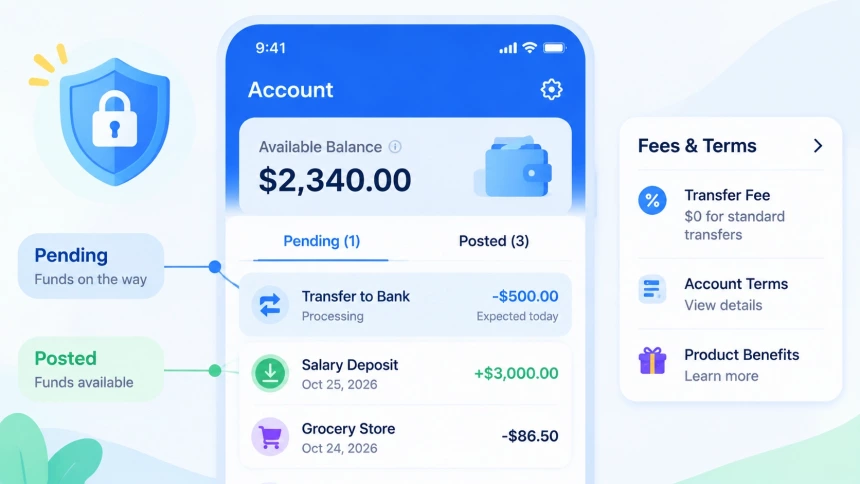
Security measures should also be easy to understand and access. Offer biometric authentication and timely alerts for suspicious transactions where appropriate. When requesting sensitive information or device permissions, explain why they are needed and how the data will be used. Regularly review financial information to keep what users see accurate and consistent.
8. Help Users Recover from Payment and Account Issues
Failed payments, account holds, and unexpected restrictions can interrupt users’ financial activities. When a problem occurs, explain what happened, why it happened, and what users need to do next. Provide an estimated resolution time and a clear way to contact support or appeal a restriction. If a linked bank account becomes disconnected or requires reauthorization, guide users through restoring the connection instead of leaving them to figure it out themselves.
Proactive support can help users resolve problems before they give up on the app. Use timely notifications to alert users to failed transactions or account issues, and offer in-app chat or chatbots for common questions. If a payment or connection failure occurs, ask for feedback once the issue has been addressed.
9. Identify Inactive Users and Win Them Back
In fintech apps, inactivity is not just about fewer logins. Look for changes in financial activity, such as fewer card payments, stopped salary deposits, declining balances, or disconnected bank accounts. Use RFM analysis to identify inactive users and prioritize re-engagement efforts.
Reach out with relevant reminders, useful product updates, or incentives that encourage users to return. Make sure promotional messages are sent with proper consent and that rewards and product claims are clear and accurate.
Compliance Reminders:
Follow local marketing consent, opt-out, and data privacy requirements. Keep promotional claims truthful, ensure advertised rewards are redeemable, and avoid gamified incentives that encourage excessive trading. Check the latest regulatory requirements and platform policies before launching campaigns.
A 30-60-90 Day Plan to Improve Fintech App Retention Rate
Retention rate in a fintech app depends on how far new users climb the activation ladder, from sign-up to funding, first transactions, and primary-account use. This plan has three phases: instrument the activation ladder and assign owners; test funding and first transactions with guardrail metrics; then launch primary-account and dormancy programs and review compliance.
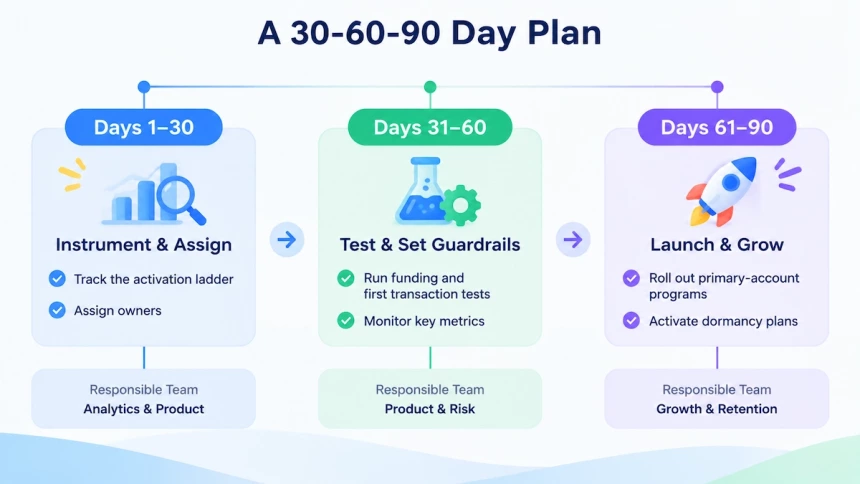
Days 1–30: Instrument the Activation Ladder
Engineering and data should add an event for every rung of the activation ladder and build cohort views of the first seven days, reporting day 1, day 7, and day 30 retention rates side by side. Each rung gets one owner: product for sign-up and verification, the lifecycle team for funding and first-transaction messages, and support for complaint themes. Risk and compliance should confirm early which rejections can state a reason publicly, since that decision shapes all later copy.
Days 31–60: Test Funding and First Transactions
Product and the lifecycle team can test a shorter funding flow, clearer prompts after funding, a guided first transaction, and reminder timing. Every test is read against two guardrail metrics: fraud rate, watched by risk, and complaint volume, watched by support. Either team can pause a test that breaches its limit. Any copy change goes through compliance before launch, and data reports results by segment.
Days 61–90: Launch Primary-Account and Dormancy Programs
The primary-account program moves recurring activity, such as bill payments or a savings rule, into the app, with rewards that offer real and consistent value. The dormancy program targets users showing churn signals: fewer sessions, unused features, or more support requests. Finally, risk, compliance, and the lifecycle team review all message templates and reward rules, so one approved set can scale while retention rate keeps improving.
Build the Relationship, Not Just the Install
Behind every strategy in this guide is the same idea: in fintech, trust is part of the product. Users hand over their money and personal data, so a hidden fee, an unexplained payment failure, or a balance that doesn’t match reality can undo months of engagement work. Retention tactics only work when the app keeps its promises on the basics.
That is also why no single team can own retention. Product designs the flows, the lifecycle team runs the messages, risk and compliance decide what can be said and offered, and support steps in when something goes wrong. The 30-60-90 day plan gives each of them a clear role, so the work doesn’t stall between teams.
The apps that users stay with are the ones that keep earning that trust long after the first transaction and the first bonus. You don’t need to change everything at once. Take one strategy from this guide, test it with your next group of new users, and bring product, risk, compliance, and support into the room from the start. Every step you make easier and every promise you keep gives users one more reason to stay. The best time to begin is now.
FAQs
How do you calculate retention rate for a fintech app?
Day-N retention = users in a sign-up cohort who are active on day N ÷ users in that cohort × 100%. Count a financial action, such as a transaction or deposit, as “active,” not just a login.
What is a good retention rate for a fintech app?
It varies by product type and how “active” is defined, so outside benchmarks are hard to compare. Track your own cohorts over time instead.
Which retention strategy should a team with limited resources start with?
Start with the biggest drop-off on the activation ladder, often verification or first funding. Fixing the path to the first transaction usually matters more than rewards or cross-selling.
Why do users stop using fintech apps?
Many stall at verification or funding before seeing any value. Others leave when trust breaks, through hidden fees or failed payments, or when the app never becomes their primary financial app.