


Keywords still matter on Google Play. They just no longer decide where an app ranks. Google’s official guidance highlights several key areas that influence app discovery and ranking — including relevance, app quality, editorial content, and advertising.
Unlike Google Search, Google Play does not release named algorithm updates. Its ranking system evolves through continuous refinement rather than major announced releases. In 2026, Google Play’s product changes point toward the same direction, with conversational discovery through Ask Play, deeper Gemini integration, and expanded Play Console insights into reach and retention.
These moves all reward apps that perform well after discovery — which are key indicators of app quality in practice, through signals like retention, engagement, technical performance, and listing conversion. The question that decides your rank is no longer only whether an app matches a query, but whether it delivers value after install.
This guide breaks down the Google Play ranking factors shaping ASO strategy in 2026 — metadata, store listing performance, user behavior signals, and app quality — and how to act on each.
Key Takeaways
- Ranking logic: Metadata earns visibility; intent-matching and app value drive ranking.
- Update cadence: Play ranking evolves continuously through ongoing signal changes.
- App value: Conversion and retention reveal real, sustained value.
- Review signal: Sentiment and recency matter more than raw star ratings.
- Technical quality: Crashes and ANRs directly hurt visibility.
- Category benchmarks: Ranking signals and success metrics vary by app category.
- Discovery channels: Ask Play and Gemini expand AI-driven app discovery.
Why Google Play Ranking Signals Are Evolving in 2026
Google Play ranking is moving beyond simple keyword matching toward a broader evaluation of user intent, app quality, and the experience users have after installation. As app discovery becomes more AI-driven, visibility increasingly depends on how well an app meets user needs and delivers long-term value.
Google’s Broader Shift Toward Understanding User Intent
Google I/O 2026 made that direction explicit, with a clear focus on AI-powered Search and semantic understanding.
That broader shift is consistent with where Google Play’s own ranking documentation already points — toward quality and relevance over raw keyword matches, and increasingly toward what happens after install.
Google Play does not directly run Google Search’s AI systems, but visibility is increasingly shaped by signals beyond metadata — how users discover, choose, and engage with an app. For ASO, that means moving from keyword optimization to intent optimization: understanding what users search for, why they pick an app, and whether it earns a place on their home screen after install.
That focus on outcomes also changes how you should read Google Play’s ranking behavior — it doesn’t move in named waves the way Search does.
Ask Play and Gemini: Google Play Moves Toward Intent-Based Discovery
In 2026, Google Play is moving toward conversational discovery. With Ask Play and deeper Gemini integration, users can describe what they need in natural language instead of relying only on keyword-based searches.
This shift reinforces a broader ASO trend: Google is increasingly focused on understanding user intent rather than matching keywords alone. A query like “an app that helps me track spending without a subscription” reflects a user goal, not just a set of search terms.
For developers, this means store listings need to communicate value clearly. Titles, descriptions, and screenshots should explain what the app does, who it helps, and which problems it solves — not simply include more keywords.
Google has not confirmed whether Ask Play or Gemini directly influence Google Play ranking signals. However, these changes point to the same direction shaping ASO in 2026: apps that better match user intent and deliver value are more likely to achieve sustainable visibility.
Google Play’s Ranking Changes Are Continuous, Not Traditional “Core Updates”
Google Search documents named updates — Core Updates, Spam Updates — on a public schedule. Google Play does not. Its ranking shifts through continuous adjustments, not identifiable update events.
That distinction matters when you read ranking changes. A sudden visibility shift does not always mean a “Google Play algorithm update.” It may come from ongoing changes — in ranking signals, user behavior, app quality, or market competition.
For ASO professionals, the takeaway is to track long-term ranking signals rather than react to individual fluctuations. Metadata, conversion, engagement, and retention together form a more reliable framework for adapting to how Google Play ranking evolves.
How ASO Priorities Have Shifted: Before vs 2026
The biggest shift is not a single update but how ranking signals are weighted. The table below summarizes the major differences between previous ASO practice and the signals shaping Google Play visibility in 2026.
These trends reflect industry analysis and ASO research, rather than officially published Google ranking factors.
| Dimension | Before | 2026 |
| Core Ranking Signal | Keyword metadata + install volume | Engagement quality + retention signals |
| Keyword Strategy | Density and repeated mentions | Intent-based, natural usage |
| Review Signal | Average star rating as the main indicator | Review freshness, velocity, and sentiment patterns |
| Conversion Rate | CRO metric only | Listing effectiveness + user relevance |
| Technical Quality | Crash and ANR as UX issues | Android Vitals as a quality signal |
Google Play Ranking Factors in 2026: Metadata, Conversion, and Retention Signals
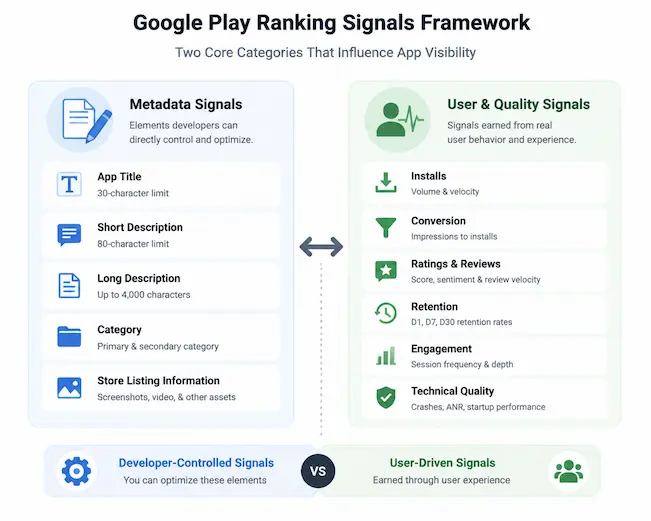
Google Play ranking signals can be grouped into three key areas: Metadata, Conversion, and Retention Signals. Together, these factors show how app visibility is shaped by both store optimization and real user experiences.
Metadata Signals: Building Search Relevance
Metadata remains one of the primary ways Google Play understands an app’s purpose and search relevance. In 2026, effective Google Play metadata optimization is no longer about adding as many keywords as possible. The focus has shifted toward matching user intent with clear, natural, and meaningful descriptions.
App Title Optimization
The app title remains one of the strongest fields for keyword relevance, with a 30-character limit on Google Play. A well-optimized title balances brand identity with high-value keyword concepts rather than a list of search terms.
Keyword stuffing is not just ineffective — it can also create compliance risks. Google Play’s Metadata policy prohibits repetitive or excessive keyword usage in store listings. A clear title that explains what an app does and communicates a strong value proposition is more effective than one overloaded with search terms.
In 2026, title optimization is increasingly about relevance and clarity. The strongest titles help both search systems and users quickly understand the app’s purpose.
Short Description Optimization
The short description combines search relevance with conversion potential within an 80-character limit. Because it appears prominently on the store listing, it should quickly communicate the user problem, highlight the main benefit, and reinforce the app’s value proposition.
Naturally incorporating relevant keywords into the short description can support search visibility. Industry ASO analysis has found positive relationships between short-description keyword usage and ranking performance, although correlation does not necessarily prove direct causation. This makes the short description a valuable optimization area for improving both discoverability and user understanding.
Long Description Optimization
The long description supports broader semantic relevance and helps users understand an app’s features, benefits, and use cases. With up to 4,000 characters available, developers should prioritize the opening section because it is the first area users encounter when evaluating the app.
Modern ASO favors natural keyword placement, feature explanations, and content that addresses user needs rather than repetitive keyword usage. A well-structured description improves both search understanding and conversion by connecting app capabilities with user intent.
Categories, Custom Store Listings, and Promotional Content
Store categories, custom store listings, and promotional content are not direct keyword ranking fields, but they influence how users discover and interact with an app.
Category selection helps Google Play understand an app’s market context. Custom store listings allow developers to tailor messaging for different audiences, regions, or acquisition sources. Promotional placements can increase exposure and generate user activity that contributes to broader visibility signals.
These elements influence rankings indirectly through discoverability, user response, and overall store performance. They should therefore be viewed as part of a broader visibility strategy rather than isolated ranking factors.
Conversion Signals: Driving User Decisions
User response signals show whether the app meets expectations after discovery. In 2026, ASO analysis increasingly focuses on acquisition quality and conversion performance because they reveal whether visibility translates into meaningful installs.
Install Growth and Download Velocity
Install volume alone does not fully explain app performance. A large download history does not automatically guarantee stronger visibility. Instead, ASO analysis increasingly considers acquisition quality, growth consistency, and market momentum.
Download velocity is often used as an acquisition indicator to evaluate how quickly an app is gaining users compared with category trends and competitive benchmarks. Consistent, high-quality acquisition is generally more valuable than short-term spikes driven only by volume.
Conversion Rate as a Ranking Signal
Conversion performance measures how effectively a store listing turns impressions into installs. The app icon, screenshots, preview video, description, ratings, and overall listing experience all influence whether users choose to download after discovery.
Conversion is no longer viewed only as a downstream result of ASO. Many ASO studies consider strong conversion performance an indicator of relevance, user alignment, and listing effectiveness.
Optimizing conversion requires more than improving individual assets. The icon, screenshots, video, and description should work together to match user expectations and clearly communicate the app’s value. When they align, more impressions can translate into meaningful installs.
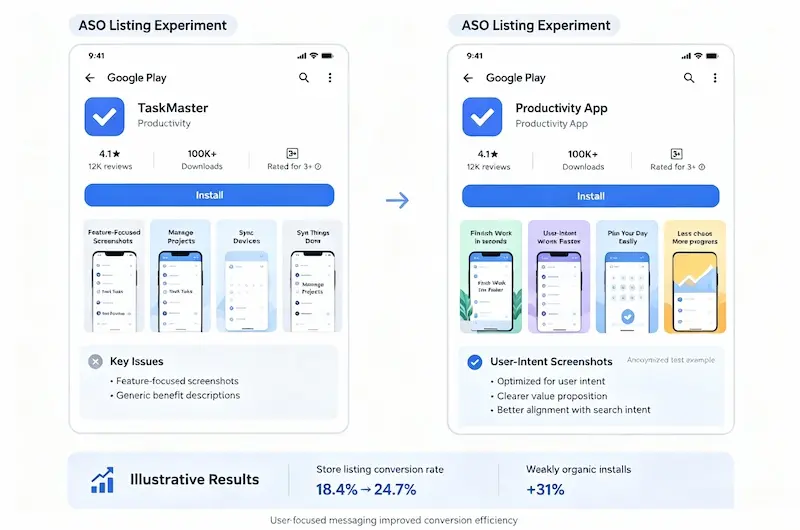
An anonymized productivity app improved its listing by shifting from feature-focused messaging to user-intent-driven screenshots and descriptions. Within eight weeks, conversion increased from 18.4% to 24.7%, and weekly organic installs grew by 31%. The result shows that clear value communication matters more than keyword volume.
Retention Signals: Sustaining Long-Term Value
Engagement, retention, and app quality indicators reveal whether the app continues to provide value after installation.
In 2026, ASO analysis increasingly emphasizes post-install behavior because long-term user satisfaction provides deeper insight into overall app quality. While Google does not publicly disclose its complete ranking formula, these signals help explain why some apps maintain stronger visibility over time.
Ratings, Reviews, and Review Velocity
Ratings and reviews remain important indicators of user satisfaction, but average star ratings alone do not tell the full story — recent feedback, rating trends, and overall sentiment matter just as much. That’s why many teams pair this signal tracking with an active review management strategy.
ASO research increasingly considers review patterns as part of understanding user satisfaction. Apps with consistent, authentic feedback and strong recent user sentiment often demonstrate healthier user experiences than apps relying only on historical ratings.
For example, an app with a slightly lower average rating but improving recent feedback may present stronger current quality signals than an app with a higher rating but declining user sentiment. This reflects a broader shift toward evaluating current user experience rather than relying only on historical performance.
Retention and Engagement Signals
Retention reflects whether users continue finding value in an app after installation. Metrics such as Day 1, Day 7, and Day 30 retention provide insight into whether an app successfully meets user expectations beyond the initial download.
Strong retention does not simply indicate more active users — it suggests that the app delivers lasting value. Long-term satisfaction often correlates with healthier user behavior, including continued engagement, positive reviews, and sustainable growth.
For ASO strategies in 2026, the goal is no longer only to generate app installs. Developers need to create experiences that encourage users to return, engage, and continue using the app over time.
Android Vitals and Technical Quality
Google Play publishes clear technical quality thresholds through Android Vitals. Apps that exceed these limits may experience reduced visibility, making technical performance an important part of long-term app quality.
For user-perceived crashes, Google defines a bad behavior threshold of 1.09% of daily users across all device models and 8% for a specific phone model. For user-perceived ANRs, the thresholds are 0.47% overall and 8% per phone model.
Google typically evaluates these metrics using the previous 28 days of data. If an app exceeds device-specific thresholds, Google Play may reduce discoverability on affected devices and may show a warning on the store listing.
For ASO teams, the takeaway is simple: technical quality is not just a developer concern. Stability issues can damage user experience, retention, and ultimately an app’s ability to maintain visibility.
How to Measure App Quality: Retention Benchmarks and User Engagement
Google Play does not publicly disclose retention thresholds for ranking. Even so, retention and engagement metrics remain useful indicators of whether an app delivers lasting value.
Instead of chasing a single “good” retention number, compare your performance against category expectations and track whether user quality improves over time. A casual game, a finance app, and a productivity tool follow different retention patterns, because user intent and usage frequency differ.
The benchmarks below are directional industry references, not Google-defined ranking standards.
Retention Benchmarks Across App Categories
Retention benchmarks show whether users keep finding value after installation. These numbers vary by category, business model, and usage pattern.
A puzzle game may run on frequent short sessions, while a finance app may see lower daily use but stronger long-term retention. Judging both against the same target leads to misleading conclusions.
The ranges below come from ASO industry analysis. Use them as directional references to spot opportunities, not as fixed requirements.
| Metric | How to Interpret Performance | Why It Matters |
| Early uninstall rate (first 48 hours) | Meaningfully below your category’s average | Indicates whether the first experience delivers enough value to prevent early abandonment |
| D1 Retention | Above the median for your category, not an absolute number | Shows whether users find immediate value — this varies too much by category for a single universal target |
| D7 Retention | Trending flat or improving, not declining sharply from D1 | Reflects whether early engagement turns into a habit |
| D30 Retention | Stable relative to your own historical baseline | Indicates longer-term product value; comparing across categories is usually misleading |
Retention benchmarks tell you whether your acquisition brings in valuable users or just inflates install volume without engagement.
How to Evaluate Your App’s User Quality Signals
Retention metrics only become meaningful alongside broader user behavior. Instead of tracking installs alone, check whether users complete a core action, return after install, and keep engaging.
Use this checklist to audit user quality signals:
- Are users completing a core first-session action?
A strong first session usually means users grasp the app’s value fast and do what they came to do. - Is Day 1 retention unusually low for your category?
Heavy early abandonment often signals a gap between expectation and the real experience. - Did retention rise or fall after your last update?
Post-release retention moves show whether new features, UX changes, or performance fixes are improving the experience. - Are your acquisition channels bringing engaged users, or just installs?
Quality acquisition leads to real engagement, not just short-term download growth.
These signals connect acquisition performance to real user value. In 2026 ASO, it is not just about more installs — it is about users who keep finding value. Engaged users contribute to stronger product signals, which can support long-term visibility and sustainable growth.
How Google Play Ranking Factors Vary Across App Categories
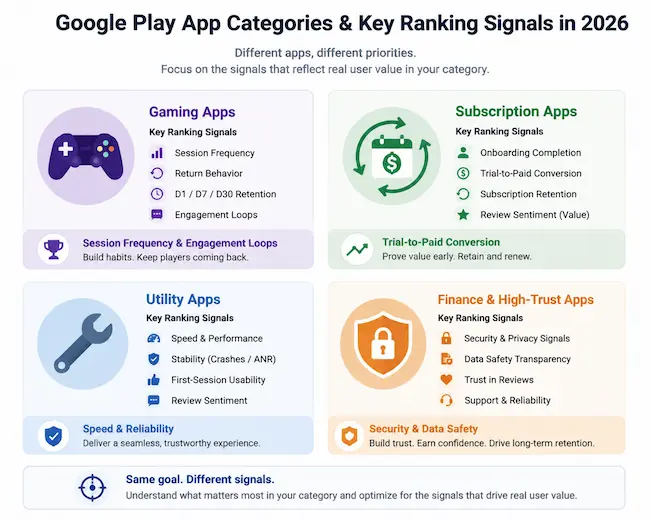
Google does not publish category-specific ranking rules. But industry analysis shows ranking signals affect app categories differently, because user expectations, engagement patterns, and product goals vary across games, subscription apps, utilities, and high-trust services.
A retention metric that signals success in one category can mean something completely different in another. Frequent daily sessions are critical for games, while reliability and trust matter more for finance apps.
Understanding these category-specific patterns helps you focus on the signals that reflect real user value in your market.
Gaming Apps
Gaming apps are among the most engagement-driven categories on Google Play. Their performance ties closely to retention curves, session frequency, and repeat-usage habits.
Games often experience significant early churn during onboarding and the first few sessions. Against that backdrop, a small share of top-performing titles often achieve much stronger long-term retention than the broader category average. because they succeed in building recurring play habits where most titles do not.
For gaming apps, optimization should focus on reducing onboarding friction, strengthening engagement loops, and improving return behavior.
Subscription Apps
Subscription apps run on a different value model. Success depends less on frequent short-term use and more on whether users grasp the value and keep paying over time.
Key signals include onboarding completion, trial-to-paid conversion, and subscription retention. Strong acquisition means little if users do not see the value before the trial ends.
User feedback adds context. Reviews that mention value, usefulness, or whether the app is “worth it” reveal deeper satisfaction than generic star ratings.
These behaviors likely feed into the same underlying engagement and retention signals covered earlier — they simply show up differently for a paid product than for a free one. A low trial-to-paid conversion rate or an early cancellation spike functions much like a weak D7 retention curve does for other categories: a signal that users aren’t finding lasting value.
For subscription products, clearer onboarding, better benefit communication, and lower churn are what hold onto users and revenue.
Utility Apps
Utility apps are judged by speed, reliability, and immediate usefulness. Users open them with a specific goal, so technical issues or friction can damage the experience fast.
Watch review sentiment, technical stability, and first-session usability. Crashes, ANRs, or slow startup create negative experiences that hit retention and reviews.
Because utility apps serve practical tasks, users expect them to work right away. Cutting first-interaction friction and keeping performance reliable keeps reviews and retention healthy.
Finance and High-Trust Apps
Finance and high-trust apps face different expectations. Beyond function, users weigh security, transparency, and reliability before they share personal or financial information.
Important signals include trust-related reviews, data-safety transparency, and overall confidence. Reviews mentioning security, reliability, and support reveal more about trust than rating averages.
The Data Safety section matters most here. Incomplete or unclear disclosures can erode confidence and hurt conversion before any visibility impact shows up.
For finance and high-trust apps, credibility is not just compliance — it is core to acquisition, conversion, and long-term retention.
Different app categories may rely on different ranking signals, but successful ASO follows the same principle: optimize for what users value. The right user signals help build visibility, and stronger visibility drives sustainable installs. Match your ASO strategy to what your users actually need.
What This Means for Your ASO Strategy in 2026
Google Play’s ranking signals keep evolving, and ASO has to evolve with them. In 2026, optimization connects what users search for, how they respond to the listing, and whether they stay after install. The earlier sections explained which signals matter. This section turns those signals into a working system.
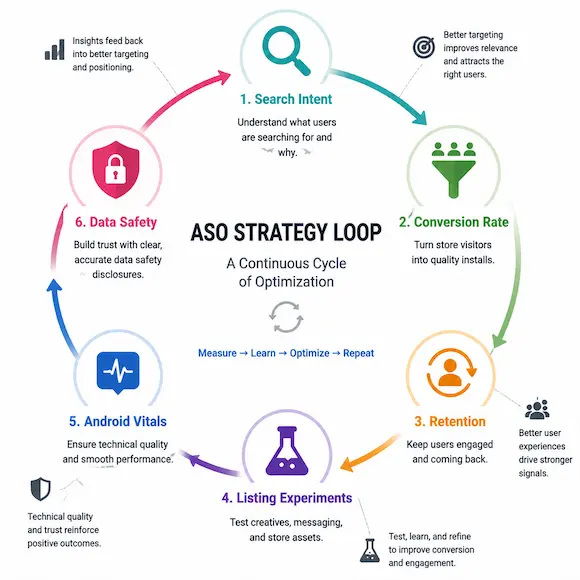
Optimize for Search Intent
Keyword targeting still matters, but its role has changed. The goal is not to maximize keyword frequency. It is to write metadata that matches what users are actually trying to do.
Map search intent across three levels:
- Category-level intent: what kind of solution does the user want?
- Problem-level intent: what need or challenge drives the search?
- Feature-level intent: what specific capability does the user expect?
Spread these layers across the title, description, screenshots, and other store assets. The strongest listings do not just contain keywords. They show why the app fits the user’s specific need. When you’re prioritizing a large keyword set, a systematic approach to finding Google Play store keywords can help identify the terms that best match user intent and business goals.
Track Conversion Rate as a Growth Metric
Ranking visibility creates opportunities. Conversion decides whether they become installs.
Monitor conversion alongside keyword rankings instead of treating it as a separate CRO task. Optimize icons, screenshots, video, and listing structure based on how well they communicate value.
A practical ASO dashboard combines four views:
- keyword visibility
- store listing conversion rate
- install trends
- user quality signals
This shows whether ranking gains attract the right users, or just produce impressions that go nowhere.
Build Retention Into the ASO Loop
Retention is a feedback channel for ASO teams. It shows whether acquisition brings in users who keep finding value.
A complete measurement loop connects store discovery, install, engagement, retention, and visibility trends. Tracking D1, D7, and D30 retention next to ASO performance shows whether changes in keywords, creatives, or acquisition sources bring in higher-quality users.
Retention sits between acquisition quality and sustained visibility. When users stay engaged, reviews, engagement patterns, and organic growth tend to follow.
Run Listing Experiments on a Loop
Store listing optimization is not a one-time redesign or a single A/B test. Strong ASO teams treat experimentation as a continuous process.
Test on a regular cadence:
- screenshots and visual hierarchy
- value propositions and messaging
- localized store experiences
- seasonal and audience-specific variations
Winning variations do two jobs: conversion lift and user-value insights. Feed those learnings back into metadata, creative, and acquisition decisions.
Watch Android Vitals With ASO
Fold Android Vitals into the same review cadence as ASO. Since Google evaluates crash and ANR rates against fixed thresholds (1.09% for crashes, 0.47% for ANRs, based on a 28-day window), set an internal warning level below those limits — for example, flag any release that pushes crash rate above 0.8% so the team can react before it risks a Play Store visibility penalty. Track this alongside keyword rankings and conversion in the same weekly or biweekly review.
Keep Data Safety Accurate
Keep disclosures accurate and complete. For trust-sensitive categories like finance, health, and productivity, incomplete information creates hesitation at the install moment. The risk shows up in conversion before visibility, as noted in the category section.
Match metadata to intent, convert impressions into installs, keep users engaged, and hold the quality bar high. Strong signals build visibility, and visibility keeps installs coming.
2026’s ASO Shift: Visibility Starts With Relevance, Growth Depends on Value
The biggest shift in Google Play ASO for 2026 is simple: metadata still helps apps get discovered, but user experience determines whether that visibility turns into sustainable growth. Apps that deliver real value are more likely to maintain strong performance, while those focused only on keyword optimization may struggle to retain users over time.
Start by identifying your biggest growth gap — whether it is unclear positioning, misleading store messaging, weak conversion assets, or technical issues affecting ratings and retention. Fix the most impactful issue, measure the results, and continue improving the signals that matter most.
The future of ASO is not about optimizing for algorithms alone. It is about creating a stronger connection between user intent, store experience, and real app value.

