

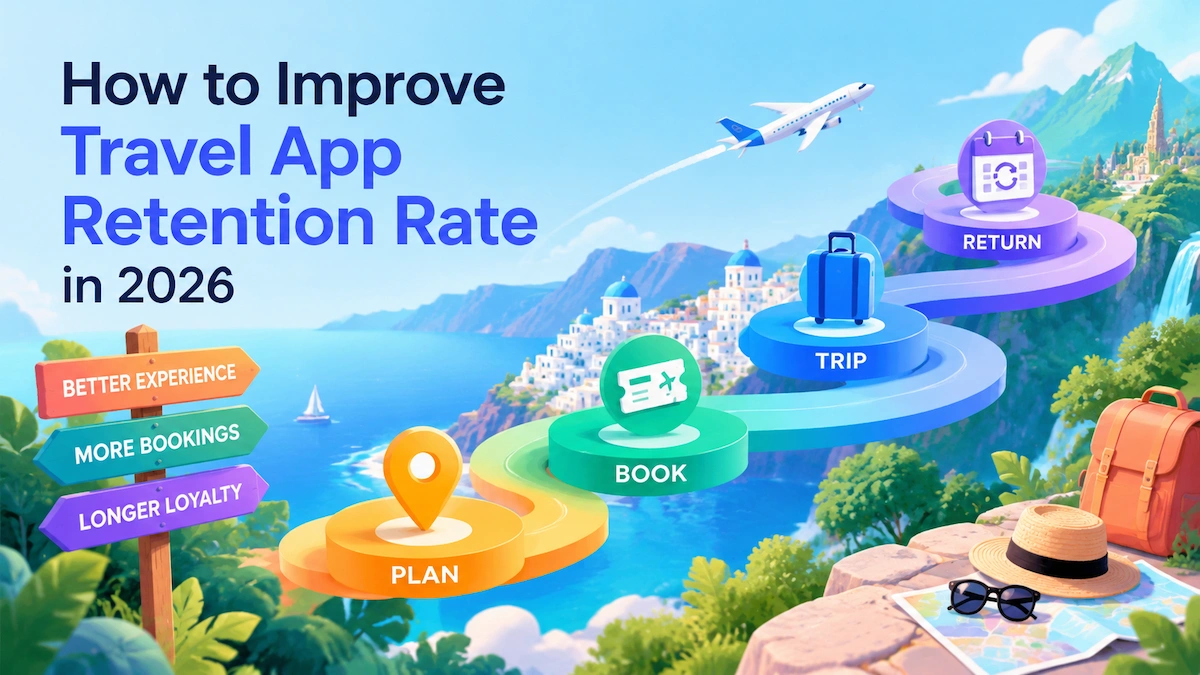
Travel apps face a unique retention challenge: users may open them frequently while planning a trip, comparing flights, or booking hotels, then go weeks or months without returning. Unlike apps built around daily habits, travel apps must give users a reason to come back even when they have no immediate plans to travel.
Improving travel app retention rate means more than sending reminders or offering discounts. It requires understanding what travelers need before booking, during their trip, and between journeys. This guide covers seven practical strategies to help travel apps improve the user experience, encourage repeat bookings, and re-engage inactive users.
Key Takeaways
- Retention follows the travel cycle. Usage peaks during planning and booking, then drops after the trip. Give users a reason to return between trips.
- Map retention to four stages. Track planning, booking, the trip, and the time between trips, then pick tactics for the stage where users drop off.
- Remove friction before and during booking. Match the experience to traveler intent, save progress, and send event-based notifications that link to the right screen.
- Stay useful after booking. Put tickets and itineraries within a tap or two, send proactive updates when plans change, and make rebooking quick.
- Measure beyond D1, D7, and D30. Add repeat booking rate, booking completion rate, and return-to-plan frequency, and segment users by lifecycle stage.
What Makes Travel App Retention Different?
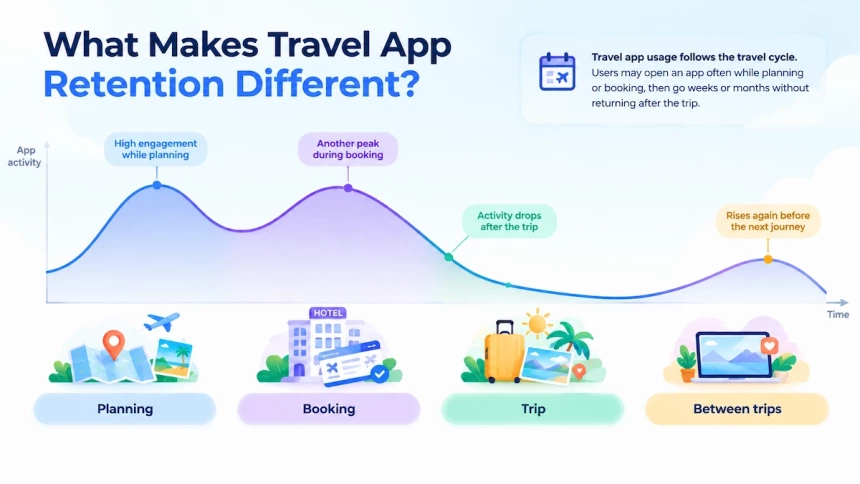
Travel app retention is closely tied to the travel cycle. Users may open an app often while comparing flights, booking hotels, or planning an itinerary. Once the trip ends, their need for the app often declines until the next journey.
Seasonality adds a further factor. AppsFlyer analyzed 293 travel apps in the US and seven European markets from January 2022 to June 2025. Installs spiked in July and August, with a smaller spike in January. The strongest spikes came from organic installs. The same dataset shows Android day-one organic retention rose from 17% in 2024 to 18% in 2025. Retargeting also drove over 75% of total conversions in travel apps.
Retention goals should therefore reflect each app’s primary use case, not install volume. Flight and hotel booking apps may track repeat searches and completed bookings as proxies for retention. Itinerary apps may prioritize engagement before and during a trip.
A practical starting point is to analyze retention across four stages. These stages are pre-trip planning, booking, the trip itself, and the period between trips. The last stage includes post-trip activity such as reviews and rebooking. Each stage may call for different engagement tactics. Examples include price alerts while planning, booking reminders, in-trip support, and personalized offers between trips.
7 Travel App Retention Strategies Across the Traveler Journey
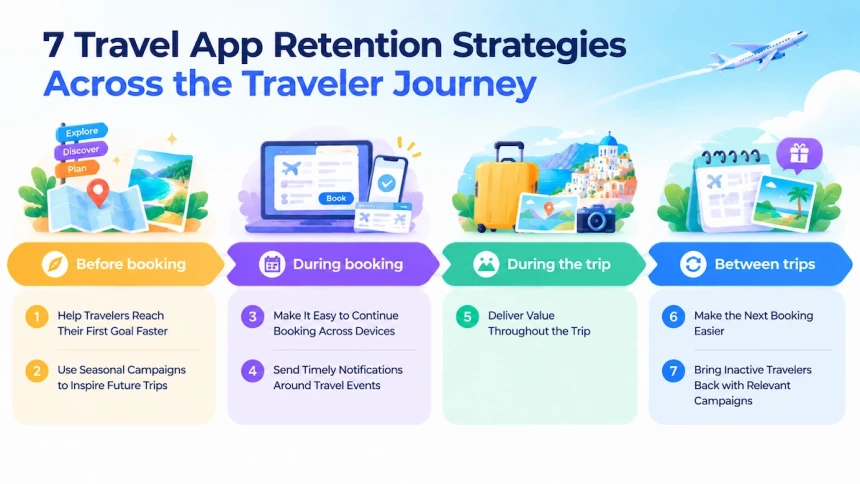
Travel app retention depends on what travelers need at each stage of their journey. Before booking, they need inspiration or help finding the right option. During booking, they want a smooth checkout. During the trip, they need timely, useful information. Between trips, they need a reason to return when they are ready to plan again.
The seven strategies below address these needs across four stages of the traveler journey.
| Traveler stage | Retention strategies |
| Before booking | 1. Help Travelers Reach Their First Goal Faster; 2. Use Seasonal Campaigns to Inspire Future Trips |
| During booking | 3. Make It Easy to Continue Booking Across Devices; 4. Send Timely Notifications Around Travel Events |
| During the trip | 5. Deliver Value Throughout the Trip |
| Between trips | 6. Make the Next Booking Easier; 7. Bring Inactive Travelers Back with Relevant Campaigns |
Choose strategies based on where users disengage. If new users leave before searching, start with Strategy 1. If they abandon checkout, focus on Strategies 3 and 4. If engagement drops during or after a trip, consider Strategies 5, 6, and 7 as appropriate. The final section explains how to prioritize improvements using retention data.
1. Help Travelers Reach Their First Goal Faster
A travel app’s first experience should help users find what they need without unnecessary steps. Some already know their destination and dates, while others are still exploring. The experience should support both.
- Match the experience to traveler intent. Let users with a clear destination search for flights or accommodation directly. For those still exploring, offer destination guides, popular routes, or recommendations. Give users a choice instead of forcing everyone through the same onboarding flow.
- Use deep links to open relevant content. Deep links take users from an ad, email, or shared link directly to the matching in-app screen instead of the home page. This helps travelers reach relevant content faster and reduces unnecessary navigation.
- Preserve users’ progress. Save destinations, travel dates, passenger counts, and search filters so users can resume planning without entering the same information again. Reducing repeated effort makes it easier for them to continue where they left off.
- Measure progress toward the first meaningful action. Track the percentage of new users who complete their first search, save a destination, or begin a booking. Measure how long these actions take, identify drop-off points, and compare subsequent retention between users who complete the action and those who do not. Choose a milestone that fits the app’s purpose.
The goal is to help travelers achieve something useful in their first session, giving them a reason to return.
2. Use Seasonal Campaigns to Inspire Future Trips
Travel demand changes with the seasons. Users may browse destinations and compare prices before a trip, then stop using a travel app until they plan their next one. Seasonal campaigns can give them a reason to return.
Use saved destinations, wishlists, and browsing history to understand users’ travel interests. Plan campaigns before key travel periods, giving users time to explore destinations and compare options. For example, users who save beach destinations could receive summer travel ideas, while those tracking flight prices could get alerts when fares change. Tools such as fare calendars or price tracking can also help users decide when to book.
The goal is to give users a timely reason to return. Relevant destination ideas and useful price alerts can keep your app part of their travel planning process until they are ready to book.
3. Make It Easy to Continue Booking Across Devices
Travelers may compare flights, check hotel options, or review booking details before making a decision. Some may leave the app to check other options and return later. If they have to repeat searches or re-enter information, they may abandon the booking. Making it easy to resume the process can reduce this friction.
Use deep links to take users from mobile websites, emails, or text messages directly to relevant screens in your app. Keep saved destinations, recent searches, and booking details in sync so users can continue where they left off instead of starting over.
Omio offers an example of a connected booking experience. Users who booked on desktop could receive a text message linking to the app, where they could view their tickets. This approach helped connect desktop bookings with mobile app use. The company reported a 15% increase in mobile app installs and twice as many engaged app users through this strategy.
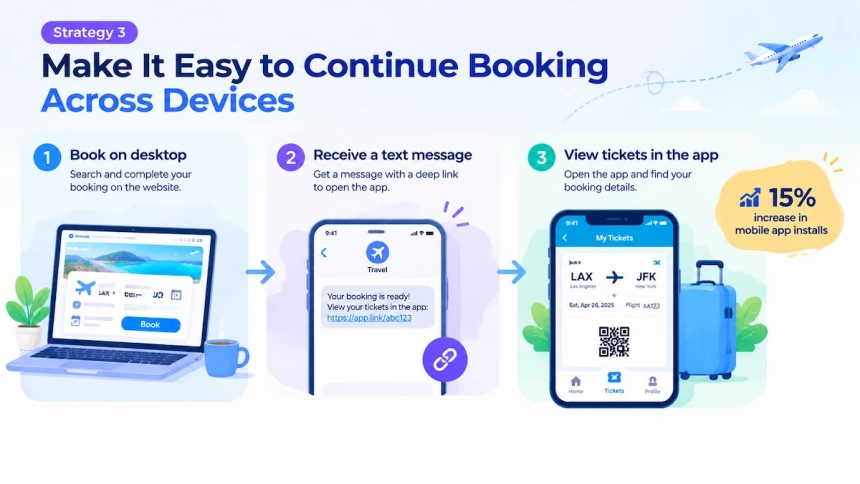
To measure whether the booking experience is improving, track web-to-app transitions, search-to-booking completion rates, booking abandonment rates, and the percentage of users who complete a booking after resuming an interrupted session. These metrics help identify friction points and show whether users can complete bookings more easily.
4. Send Timely Notifications Around Travel Events
Travel apps can use timely notifications to help users complete bookings and manage their trips. Price changes may prompt users to revisit search results, unfinished bookings may need a reminder, and flight changes require timely updates. Each message should respond to a specific event in the traveler’s journey.
TOMOGO!, a travel app for visitors to Japan, uses automated messaging flows to encourage users to complete tour bookings. After an initial notification, the app waits a day before sending a follow-up push notification. Users who complete a booking exit the flow, while those who have not booked can receive another reminder. The post-app-open booking flow achieves a conversion rate of around 12% to 13%, according to the published case study. This illustrates how behavior-based reminders can support booking completion without sending the same message to every user.
The same principle applies to notification design more broadly. Link each message directly to the relevant booking, itinerary, or search results instead of sending users to the app’s home screen. Coordinate push notifications and emails to avoid duplicate reminders, and check whether a message is still relevant before sending it.
5. Deliver Value Throughout the Trip
A booking is not the finish line. During the trip, travelers need tickets, hotel details, and quick answers when plans change. Make those moments easy, and the app earns its next open.
Start by putting essential travel information in one place, so users don’t dig through emails or juggle separate services. Bookings, tickets, and reservation details should be reachable in a tap or two.
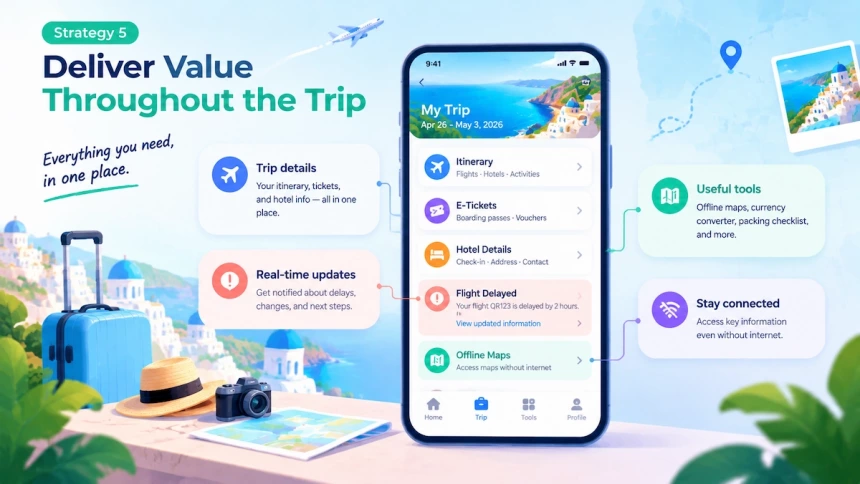
Be proactive when things go wrong. If a flight is delayed or a booking changes, send a timely update that explains what happened and guides users to the next step. Offline itineraries and digital tickets also help travelers access essential information when connectivity is limited or time is short.
Beyond handling disruptions, offer practical tools that support travelers throughout their trip. Offline maps, currency converters, and packing checklists can give users more reasons to return to the app, as long as these features align with its main purpose.
To see whether these features work, track itinerary views, travel document access, use of in-app tools, and engagement with disruption alerts. These metrics show usage, not retention. Travel demand swings with the seasons, so compare cohorts and run controlled tests before crediting any feature.
6. Make the Next Booking Easier
Travelers don’t open a travel app every day, so each new trip is a chance for them to start from scratch somewhere else. Repeat booking is growing: one industry report found purchases per paying travel-app user rose from 1.89 in 2024 to 2.13 in 2025. The data shows the trend, not which tactics drive it, but it makes the next booking worth designing for.
Two things help. First, make rebooking quick: save traveler details, payment information, preferred departure points, and accommodation preferences, and keep past bookings and saved destinations within a few taps. Second, give people a reason to stay: a tiered loyalty program with discounts, upgrades, and perks that grow with membership rewards frequent travelers for booking in the same place. Showing progress toward the next tier, such as how many bookings remain, makes the program easier to understand and gives members a visible goal.
To see whether this works, track repeat booking rate and the share of returning users who buy again. Time to complete a repeat booking shows whether the quicker flow helps, and repeat rate by membership level shows whether the loyalty program does. Segment results by user group, and measure app retention separately, since users can come back without booking.
7. Bring Inactive Travelers Back with Relevant Campaigns
Tailor re-engagement to each user’s booking history. For users who have never booked, highlight relevant destinations, current prices, or searches and booking flows they left unfinished. For past customers, recommend trips based on previous bookings and saved preferences.
For users who still have the app, use permission-based push notifications, emails, and price alerts, and respect their notification preferences. For users who have deleted the app, Apple Ads redownload campaigns can reach people who previously downloaded it, especially ahead of peak travel seasons or major promotions.
Apple Ads case studies point to the value of redownload campaigns. Omio reported that revenue from returning users reached through Apple Ads was 3x higher than from users re-engaged through other paid channels. Yanolja reported that its redownload campaign delivered an 8% higher tap-through rate and a 12% lower cost per acquisition than its new-user campaign. It also reported a 41% lower cost per acquisition for returning users making a first purchase than for new users.
Once users return, let them pick up where they left off, for example by restoring recent searches or saved trips. Measure success beyond redownloads by tracking booking conversion and subsequent retention, such as 30-day retention.
How to Measure Travel App Retention Beyond Standard Metrics
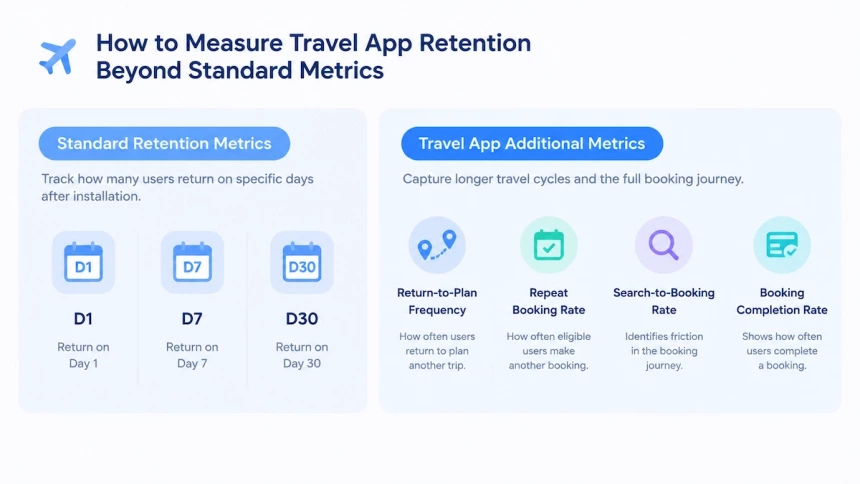
App retention is commonly measured by checking how many users return to an app on specific days after installation. D1, D7, and D30 retention refer to users who return on Day 1, Day 7, and Day 30, respectively. These metrics provide a useful starting point, but they may not capture the full user lifecycle of a travel app. People may plan or book trips only a few times a year, so users who are inactive at D30 may still return when planning their next trip.
To measure retention across longer travel cycles, track how often users return to plan another trip, alongside repeat booking rate. Search-to-booking rate and booking completion rate can help identify friction in the booking journey, while repeat booking rate shows how often eligible users make another booking. These metrics complement app retention but do not replace it.
Segment users by lifecycle stage, such as new installs, users who have completed a booking, travelers currently on a trip, and previously active users who have stopped engaging. Compare how each group returns to the app and where engagement drops. This helps reveal whether users are struggling to complete a booking, have no immediate need to reopen the app, or are returning for another trip. Once you know which segment is slipping, you can focus your efforts to increase app retention where they will have the most impact.
Turn Travel App Engagement into Lasting Retention
Improving travel app retention starts with understanding when travelers need your app and what helps them return. From simplifying the first booking to providing useful in-trip support and relevant offers between journeys, each interaction should serve a clear purpose.
To improve travel app retention rate, start by identifying where users drop off and which stages need work. Track retention alongside repeat bookings, booking completion, and re-engagement to understand how users respond to your changes. With a strategy built around the traveler journey, your app can create better user experiences and more opportunities for users to return.
Retention also starts with attracting the right users. A well-optimized app store listing helps travelers understand your app’s value before downloading it. By aligning your listing with relevant search intent and clearly communicating your app’s benefits, you can attract users whose needs match what your app offers and build a stronger foundation for long-term growth.
FAQs
What is a good retention rate for a travel app?
It varies by app and season. AppsFlyer data shows Android day-one organic retention at 18% in 2025, but your own past cohorts are a better benchmark.
Why aren’t D1, D7, and D30 retention enough for travel apps?
Travelers may plan trips only a few times a year, so users inactive at D30 can still return later. Also track return-to-plan rate and repeat booking rate.
How can I tell whether a new feature improved retention?
Usage metrics only show that a feature is used. Compare cohorts from similar seasons and run controlled tests before crediting the feature.
How can I win back users who deleted my app?
Use Apple Ads redownload campaigns, then restore their recent searches or saved trips. Measure booking conversion and 30-day retention, not just redownloads.
Which retention strategy should I start with?
Identify where the most users drop off. Prioritize the issue affecting the most users that your team can realistically address with available data and resources.