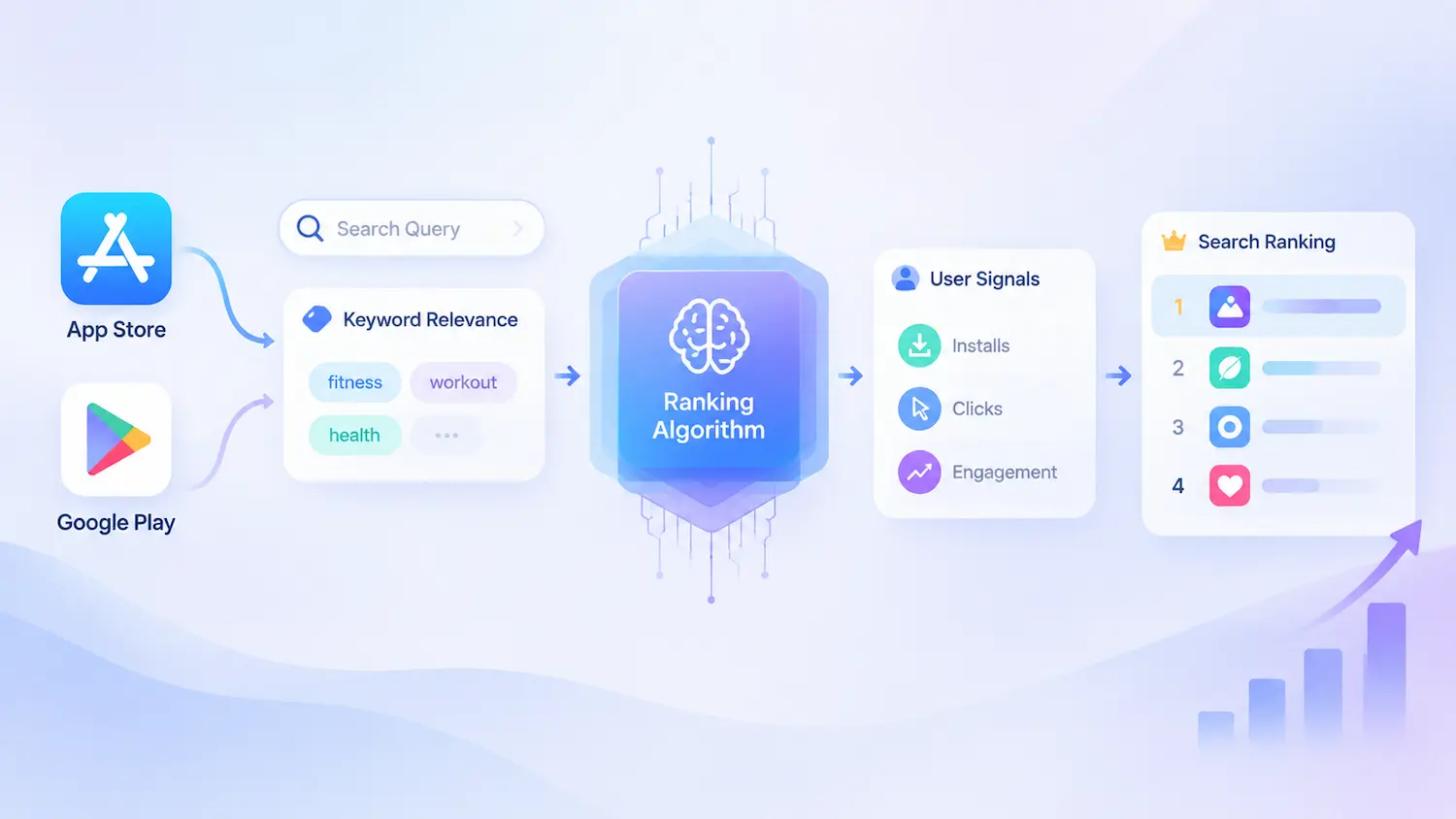


The App Store and Google Play are crowded marketplaces where millions of apps compete for attention. Even a well-built app can struggle to gain traction if potential users cannot discover it. Search plays a major role in discovery on Apple’s App Store. According to Apple, 70% of App Store visitors use search to discover apps, and nearly 65% of downloads occur directly after a search. These figures apply to the App Store and should not be treated as Google Play benchmarks. For apps on Google Play, ASO also plays an important role in helping users discover the app and understand its value through the store listing.
App store optimization (ASO) is the ongoing process of improving an app’s visibility and store listing performance on the App Store and Google Play. To understand why app store optimization is important, consider two challenges: helping relevant users find your app and giving them clear reasons to download it. ASO addresses both, although results depend on search demand, competition, and product quality.
This guide explores the main benefits of ASO, its role in sustainable app growth, and how businesses can measure its impact.
Key Takeaways
- ASO improves app visibility and discoverability across the App Store and Google Play.
- Relevant keywords help attract users whose search intent matches what your app offers.
- A well-optimized listing supports both organic downloads and conversion, which makes paid traffic more efficient as well.
- Localization helps apps reach new audiences in international markets.
- Apple’s Custom Product Pages and Google Play’s custom store listings let you tailor the store experience to specific searches and audiences.
- Measure ASO across visibility, conversion, downloads, and acquisition costs, and compare results with your own baseline.
- ASO creates opportunities rather than guarantees, so continuous testing and adjustment matter more as competition grows.
How ASO Supports App Discovery and Downloads
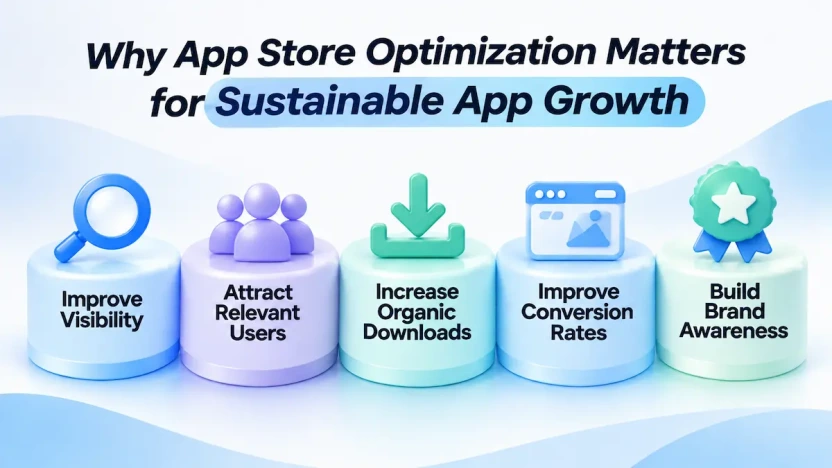
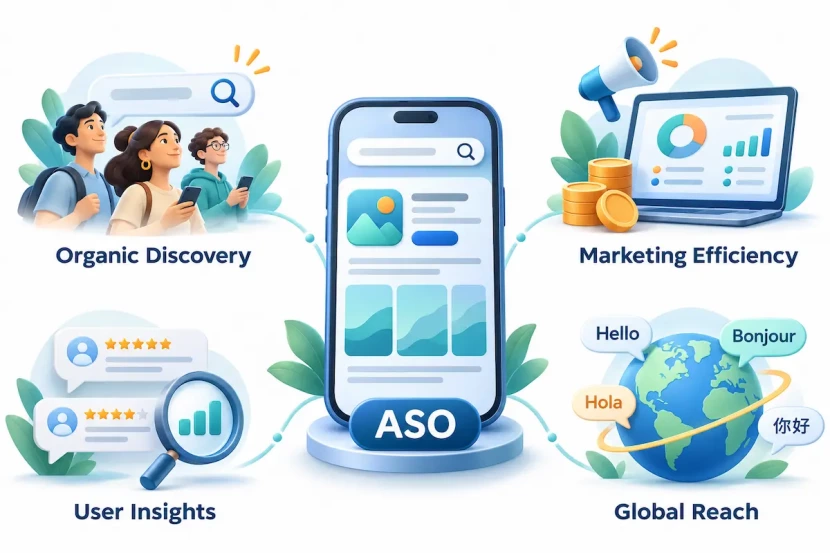
ASO supports app growth by improving visibility, attracting relevant users, increasing store listing conversion, supporting organic downloads, and building brand recognition.
Improve App Visibility and Discoverability
App store search works by matching a user’s query against information associated with each app. Developers can learn more about App Store search and the factors that help users discover apps. ASO starts with keyword research to identify the terms your target users actually search for, then places relevant terms into the metadata fields each store uses.
Accurate metadata helps stores understand which searches your app is relevant to. Start with terms that describe your app’s main features and use cases, then evaluate their demand and competition. Keyword analysis is a core part of app store optimization research, helping you identify relevant search terms and decide which opportunities to prioritize.
The two stores use different metadata structures:
| Metadata element | Apple App Store | Google Play |
| App name | App name | App name |
| Short supporting text | Subtitle | Short description |
| Dedicated keyword field | Available | Not available |
| Full description | Explains features and benefits to users | Explains features and benefits and supports search relevance |
Apple provides a dedicated keyword field that is not visible on the product page. Google Play has no equivalent field, so relevant terms should be incorporated naturally into the app name, short description, and full description. Developers should follow each store’s metadata requirements and avoid repetitive or unrelated keywords.
On both stores, metadata should communicate the app’s purpose clearly. Write for users first, and place relevant terms only where they accurately describe the product.
Text relevance is only part of the picture. Neither Apple nor Google publicly discloses its full ranking algorithm. However, Apple has stated that customer behavior — including downloads and the number and quality of ratings and reviews — plays an important role in ranking and discoverability. Visibility therefore depends on more than keyword relevance alone; app performance and user feedback also matter.
Attract More Relevant Users
Effective ASO is not about ranking for the highest-volume keywords. It is about matching real user intent. Someone searching for “apartment rentals” is likely looking for available properties to rent. An app that provides rental listings, property details, and location-based search is more relevant to this query than a general real estate app focused primarily on property sales.
Start keyword selection with the app itself: its core features, positioning, and target audience. Then evaluate whether each keyword reflects a genuine search intent your app can satisfy. Keywords that attract people looking for something different rarely produce useful downloads.
When your listing clearly communicates what the app does, users can better judge fit before they install. Better keyword relevance improves the quality of the match at the point of discovery — it does not automatically translate into higher retention or lifetime value. Those outcomes depend heavily on the product experience itself.
Improve Store Listing Conversion Rates
After users discover your app and visit its store listing, the next challenge is converting that interest into installs. Several elements influence their decision:
- App name and supporting text (subtitle on the App Store or short description on Google Play)
- App Icon
- Screenshots and App Previews
- App Description
- Ratings and Reviews
Together, these elements help users understand what the app does and what to expect. App ratings and reviews also help users assess other people’s experiences and decide whether to trust the app.
ASO also helps developers present the app’s value to users with different needs. Apple’s Custom Product Pages and Google Play’s custom store listings offer ways to tailor the store experience to specific searches or audiences, making the messaging and visuals more relevant to potential users.
For example, a fitness app could highlight no-equipment routines for people searching for home workouts, while emphasizing strength programs and progress tracking for those interested in gym workouts. This alignment can help users understand whether the app meets their needs and support their decision to download.
A clear, distinctive app icon helps users recognize the app and forms part of their first impression in search results and on the product page. Its contribution to ASO should be evaluated through user response and conversion rather than assumed improvements in search rankings.
Both stores provide tools to evaluate listing changes: Apple’s Product Page Optimization and Google Play’s Store Listing Experiments. Testing a clear hypothesis helps developers assess whether a change improves user response, providing evidence to guide future optimization.
Whatever you test, keep the visuals consistent with what the app actually delivers. Creative assets that attract clicks but misrepresent the product risk disappointing users after installation.
Increase Organic Downloads
Organic download growth depends on two connected factors: search visibility and store listing conversion. Visibility determines how often your app appears in relevant search results, while conversion determines how many interested users proceed to install it. Improving both stages helps turn more search opportunities into actual downloads.
Track whether gains in visibility and conversion translate into additional organic downloads. Interpret changes alongside search demand, competition, and overall app performance.
Build Brand Awareness and Support Long-Term Growth
Repeated exposure in relevant search results can help users recognize your app over time. Consistent naming, visual assets, and messaging reinforce that recognition across discovery touchpoints. However, impressions alone do not demonstrate stronger brand awareness. Monitor branded search trends alongside other marketing activity, and avoid attributing changes to ASO alone.
What Are the Key Business Benefits of App Store Optimization?
Improvements in app discovery and store listing performance can create broader business value. ASO can diversify acquisition channels, improve marketing efficiency, reveal user demand, and help businesses reach new markets.
Reduce Dependence on Paid Acquisition
Paid campaigns generally require ongoing spending to maintain a steady flow of new users. ASO adds another acquisition channel by helping people discover an app through store search and browsing. When an app ranks for relevant search terms, its listing can continue generating impressions, product page visits, and installs without a separate payment for every organic download.
However, ASO does not automatically lower cost per install (CPI), and organic traffic is not guaranteed. Keyword competition, market demand, and store algorithm changes all influence visibility.
Building a dependable organic acquisition channel requires ongoing work. Review keyword relevance, listing performance, and market demand regularly, especially when paid campaign costs or traffic patterns change.
Improve Return on Marketing Investment
An optimized store listing can improve the value of both organic and paid traffic. If a listing converts a higher proportion of comparable paid visitors into installs, the same advertising spend can generate more downloads, provided media costs remain stable. Insights from ASO and paid campaigns can also inform keyword research, messaging, and creative tests.
For example, suppose a car rental app finds that paid visitors searching for “car hire” convert at a higher rate than comparable visitors searching for “car rental” in the same market. This provides a hypothesis for testing local terminology in the store listing. It does not establish that the term will improve organic rankings. In the other direction, ASO research can suggest relevant car-rental themes for paid campaigns.
To measure the combined effect, track organic download share, product page conversion rate, paid campaign performance, and overall user acquisition costs. Together, these metrics provide a fuller picture of marketing efficiency than paid campaign results alone.
Keep in mind that paid downloads should not be assumed to improve organic search rankings. The value of combining ASO and paid marketing lies in making better use of traffic, improving conversion opportunities, and making more informed marketing decisions. If you need implementation support, explore app marketing services to review the available promotion and managed ASO options.
Gain Insights Into User Demand and Market Trends
ASO data can help businesses understand what potential users are looking for and how their needs change over time. Keyword research can reveal how people describe their needs, while user reviews provide qualitative insight into expectations, frustrations, and missing features. By analyzing these signals together, businesses can identify opportunities to refine their app positioning, improve existing features, or explore new product directions.
Competitor monitoring adds further context. Tracking competitors’ keywords, metadata, and store listing changes can reveal emerging positioning strategies and potential gaps in the market. Product teams can use recurring review themes to inform feature planning, while marketing teams can refine messaging and creative assets based on observed user interests.
These signals should be treated as part of the picture, not the whole of it. Search behavior and reviews represent only some users and market activity. Combine ASO insights with product analytics, direct user research, and other market data before making major product or marketing decisions.
Expand Into New Markets Through Localization
Localization helps businesses reach potential users beyond their original market. By adapting keywords, messaging, and visual assets to local search habits and cultural expectations, ASO can improve discoverability and help users understand the app’s value in each target market.
Effective localization typically involves:
- Keywords: Research local search terms, synonyms, and language variations instead of translating existing keywords word for word.
- Descriptions and messaging: Adjust product benefits and wording to reflect local language conventions and user expectations.
- Visual assets: Localize screenshots and promotional text so the app’s value is clear and relevant to local audiences.
- Market positioning: Consider cultural preferences, user demand, and competing apps in each target market.
Platform differences also matter: the two stores use different metadata structures (see the table above) and character limits. Adapt localization to each platform’s requirements and consult the relevant developer documentation, including Apple’s localization guidance.
Localization does not guarantee international growth. Its effectiveness depends on how well the app, its messaging, and its store listing match the needs of users in each target market.
How to Measure the Impact of App Store Optimization
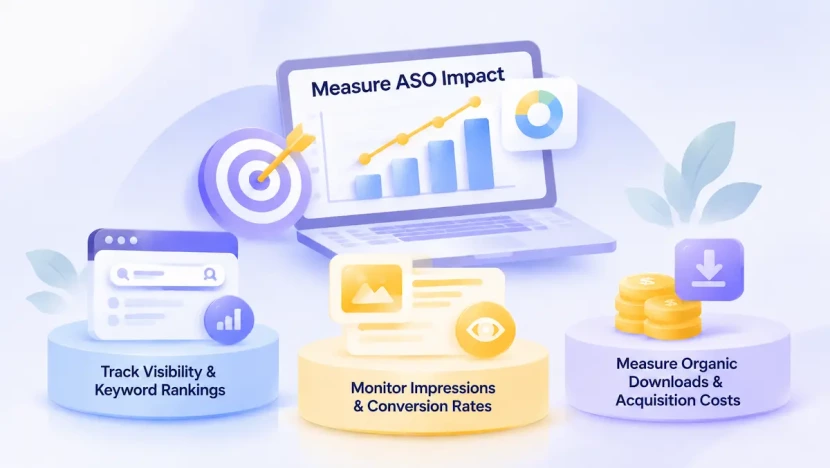
Measuring ASO performance involves evaluating the entire user journey rather than relying on keyword rankings alone. A comprehensive framework should cover search visibility, store listing engagement, downloads, and acquisition efficiency. Reviewing these metrics together helps identify performance gaps and determine which optimization efforts contribute to app growth.
Track Visibility and Keyword Rankings
Keyword rankings and search visibility show how easily potential users can discover your app in the App Store and Google Play. Monitor relevant search terms over time, especially after metadata updates, localization, or changes in the competitive landscape.
Organize your target keywords along two dimensions:
By user awareness
Branded keywords: Terms that include your app name or brand. Track these to understand how easily users familiar with your app can find it.
Non-branded keywords: Generic terms related to your app’s category, features, or use cases. These help measure visibility among potential new users.
By priority and specificity
Core keywords: High-priority terms closely related to your app’s main purpose and features.
Long-tail keywords: More specific search phrases that may attract users with clearer needs or intentions.
Compare ranking changes across these groups rather than relying on a single overall position. Strong branded visibility does not necessarily mean your app is reaching enough users through non-branded searches. Rankings show where your app appears for a query, but they do not indicate how often users search for it. An app keyword search volume strategy helps you interpret ranking changes alongside estimated demand and prioritize relevant terms. Treat volume estimates as directional signals, and use acquisition data to assess whether greater visibility translates into downloads.
Use App Store Connect and Google Play Console for the acquisition and source data each platform makes available. Do not assume that either console provides a complete query-level view of organic search traffic.
Third-party ASO tools can supplement reporting with keyword rankings and search-volume estimates, but these are not equivalent to first-party acquisition data. For a snapshot of your app’s keyword coverage and current rankings, you can use an ASO keyword research tool. A free account is required, and its Vol metric indicates relative search popularity rather than exact monthly search volume. Keep the market, device settings, and tracking tool consistent when comparing rankings over time.
Monitor Impressions and Conversion Rates
Visibility is only the first step. You also need to know whether users who discover your app visit its store page and decide to download it. Track impressions, product page views or store listing visitors, and conversion-related metrics to evaluate listing performance.
The two platforms measure different stages of the user journey, so their reported rates should be interpreted separately:
App Store Connect: According to App Store Connect Analytics, the overall conversion rate is total downloads and pre-orders divided by unique device impressions. Its denominator is unique impressions, not product page views.
Google Play Console: In 2026, Google updated its store listing performance reports to emphasize unique user clicks on Install, Open, and Pre-register buttons. Click-through rate (CTR), the percentage of store listing visitors who click one of these buttons, replaces the legacy conversion rate metric in these reports.
Compare metrics only when their definitions, denominators, and reporting periods are consistent. An Install-button click indicates intent rather than a completed installation, so track completed acquisitions separately and do not label listing CTR as an install conversion rate.
Metadata and creative updates can affect different stages of the user journey. A more relevant title may attract search traffic, while clearer screenshots may encourage visitors to install. Use the testing tools described earlier, Apple’s Product Page Optimization and Google Play’s Store Listing Experiments, to identify effective changes.
Define the hypothesis and primary metric before launching a test. Use the platform’s experiment guidance to assess whether the result is conclusive, and avoid stopping a test simply because an early result looks favorable. Test one clear hypothesis at a time so the outcome is easier to interpret. Controlled experiments provide more reliable insights than simple before-and-after comparisons.
Measure Organic Downloads and Acquisition Costs
The ultimate goal of ASO is to attract relevant users and contribute to app growth. Track organic downloads before and after major optimizations to see whether improved visibility and listing performance translate into additional installs.
Focus on these metrics:
- Organic downloads: Downloads attributed to unpaid sources where the reporting allows paid and unpaid traffic to be distinguished. Do not automatically classify all search-attributed downloads as organic.
- Organic download share: Organic downloads divided by total downloads, using the same reporting period and download definition.
- Paid installs: Installs attributed to advertising campaigns, with the attribution source and window documented.
- Paid cost per install (CPI): Advertising spend divided by attributed paid installs.
- Blended cost per install: Total acquisition-related spend divided by total installs during the same period. State which costs are included and apply the same definition consistently.
Review organic and paid acquisition trends together. For example, organic download share may increase simply because paid downloads have declined, even if organic downloads remain unchanged. Blended cost per install provides a broader view of acquisition spending across paid and organic channels, but it does not isolate the impact of ASO.
Download volume alone does not reveal user quality. If installs increase but early retention or in-app purchase rates decline, your listing may be attracting users whose expectations do not match the app. Monitor retention and the rate at which users become paying customers alongside download volume.
Finally, avoid attributing every change in downloads to ASO. Seasonality, advertising spend, competitor activity, app updates, market demand, and store algorithm changes can all affect acquisition. Establish a baseline, use consistent observation periods, and document other major changes to better evaluate ASO’s contribution.
By combining keyword visibility, conversion performance, organic downloads, and acquisition costs, you can build a clearer picture of ASO effectiveness and make better-informed optimization decisions.
FAQs
Why Is App Store Optimization Important for Small Apps?
ASO helps small apps with limited budgets and low brand awareness reach potential users through search. Targeting relevant niche keywords with manageable competition can create additional discovery opportunities, although high rankings are never guaranteed.
Can ASO Increase Organic App Downloads?
Yes. ASO can increase organic download opportunities by improving an app’s visibility for relevant searches and making its store listing more effective at converting visitors. The results depend on keyword demand, competition, and how well the app meets user expectations.
Does ASO Reduce User Acquisition Costs?
ASO may reduce blended cost per install if organic installs increase without a proportional rise in acquisition spending. A higher organic share alone is not enough to demonstrate improvement, because that share can also rise when paid installs decline. Review absolute install volumes, acquisition spending, and user quality together.
How Long Does It Take to See Results From ASO?
There is no fixed timeline. Results depend on keyword competition, app history, market demand, and the changes you make. Record a baseline and monitor performance across several optimization cycles.
Why Are App Icons Important in ASO?
An app icon shapes first impressions and brand recognition across search results and store listings. Although Apple does not identify icon design as a direct ranking factor in its public guidance, testing different icons can help improve user response and conversion.
Is ASO Still Important If I Already Run Paid Ads?
Yes. ASO complements paid advertising by supporting organic discovery and improving the conversion potential of store listings. Businesses can also use insights from paid campaigns to identify effective messaging and evaluate whether similar themes should be reflected in their store listings.
Why App Store Optimization Deserves Ongoing Attention
ASO matters because discovery and store listing performance both influence acquisition. Start by identifying the largest measurable gap: limited visibility, weak listing response, or a mismatch between the listing and the product experience. Make a focused change, evaluate it with consistent metrics, and use the result to guide the next iteration. Sustainable progress depends on relevant traffic, accurate expectations, and a product that delivers on its promise.