

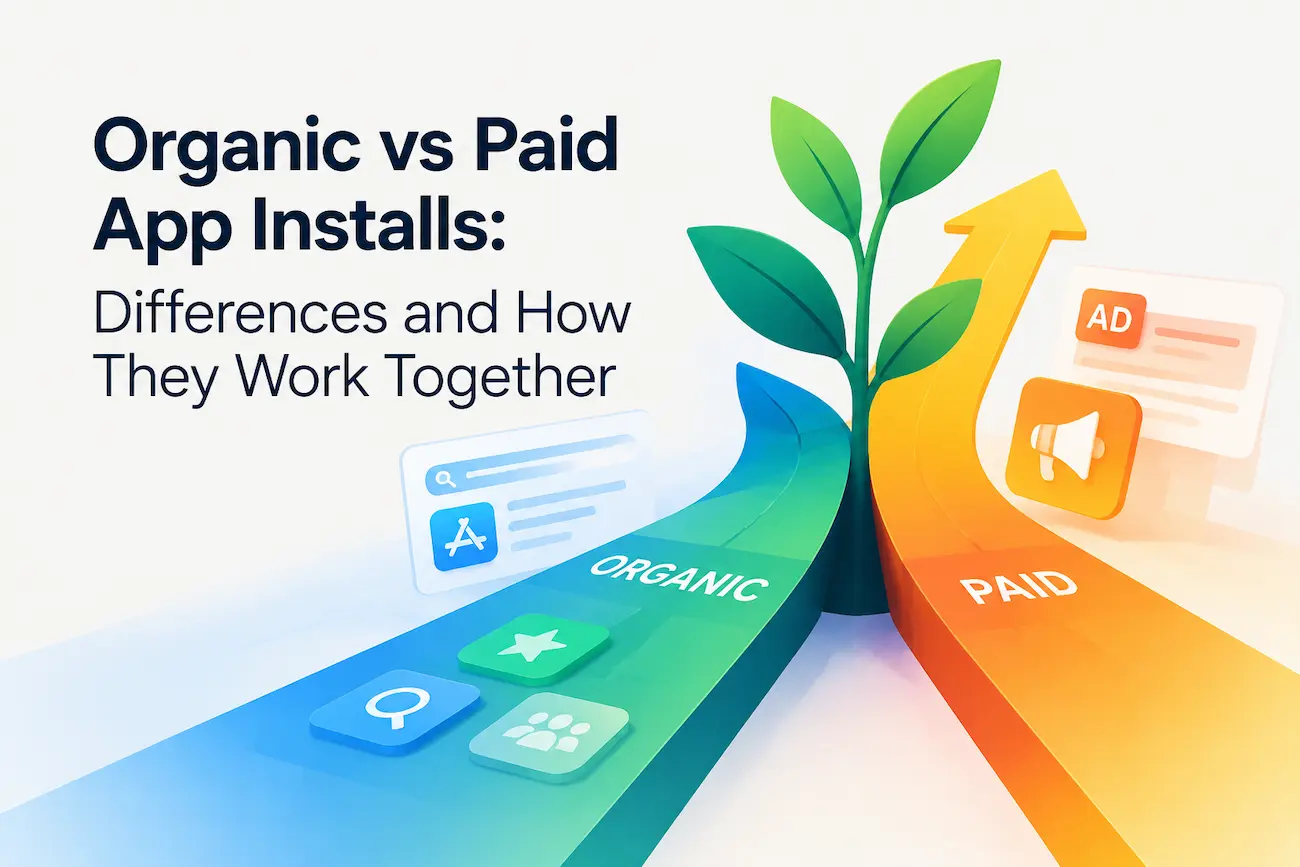
Should app developers invest more in ASO for organic growth, or in paid campaigns for faster user acquisition? In practice it isn’t either/or: organic and paid installs serve different purposes and work best combined. Organic growth builds long-term visibility through App Store and Google Play discovery; paid acquisition enables faster testing and scalable growth.
What Are Organic App Installs?
Definition of Organic App Installs
Think of an organic install as an unpaid “yes”: the user finds your app on their own — through a search, a browse listing, or a friend’s recommendation — and decides to download it without ever seeing a paid ad. The user discovers the app naturally and installs it based on their own search intent or interest.
Common sources of organic installs include:
- App Store and Google Play search
- Browse and featured placements
- Category rankings and top charts
- Similar app recommendations
- Brand searches
- External referrals and word of mouth
Organic does not mean free. Organic installs still require real work — ASO, store listing optimization, review management, and product quality.
How Users Discover Apps Organically
Organic users typically discover apps through search, rankings, recommendations, and brand demand.The journey is simple: Search query → App impression → Store listing visit → Install
Organic discovery depends on two key factors:
1. Store relevance
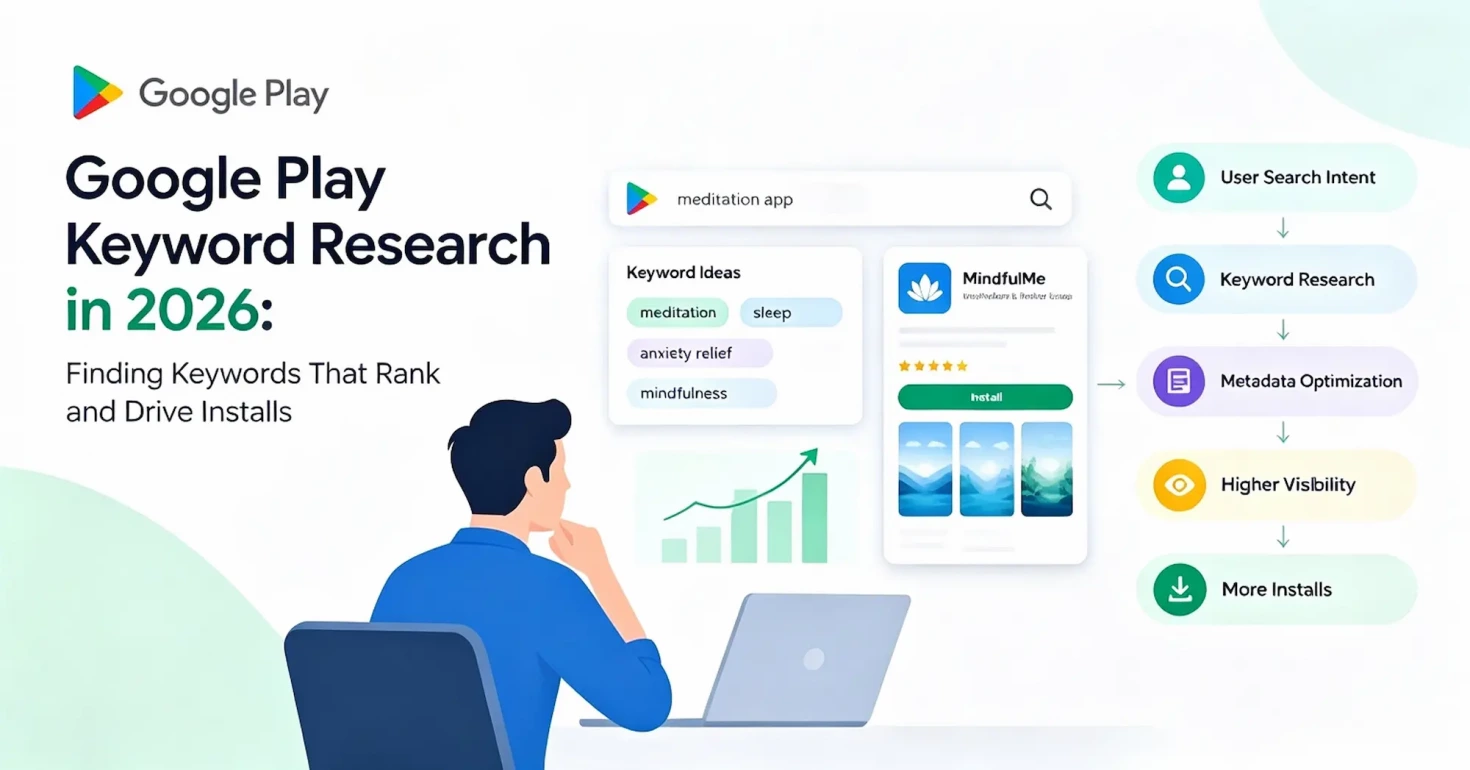
Keywords, app title, description, screenshots, and other store elements help app stores understand the app and match it with relevant searches.
2. User response
Ratings, reviews, conversion rates, and engagement signals influence how stores evaluate app performance and visibility.Strong ASO improves both discovery and conversion, helping apps reach more high-intent users over time.
However, organic growth takes time to build. New apps and competitive categories often need paid acquisition to gain early visibility and collect market insights while organic growth develops.
What Are Paid App Installs?
Definition and Sources of Paid App Installs
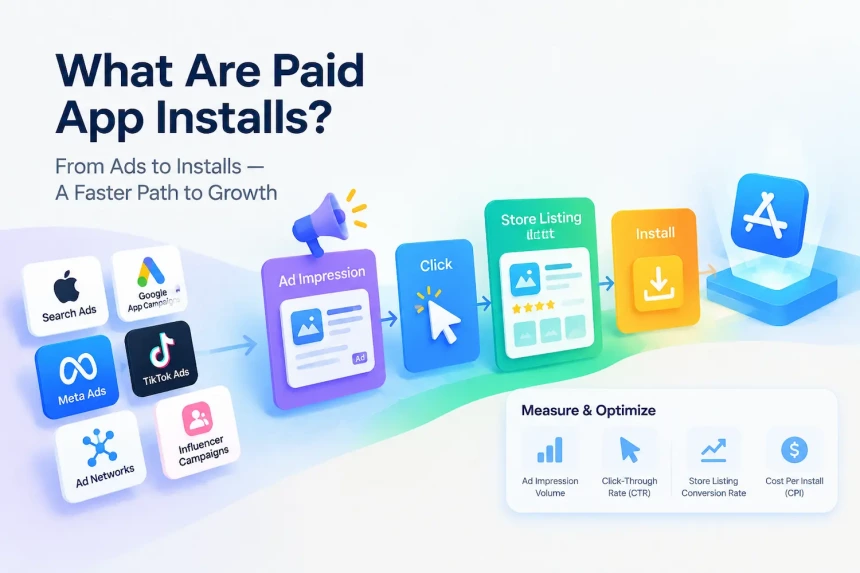
A paid app install happens when a user downloads your app after interacting with a paid promotion. The user typically sees an advertisement, clicks through to your store listing, and completes the installation. Paid installs are often used for user acquisition, market testing, and scaling.
Common sources of paid app installs include:
- Apple Search Ads
- Google App Campaigns
- Meta Ads
- TikTok Ads
- Ad networks
- Influencer campaigns
The key difference is that paid installs require direct spending for user acquisition. However, paid campaigns are not only about buying downloads. They also provide measurable performance signals that help teams evaluate acquisition efficiency.
How Paid App Acquisition Works
Paid app acquisition usually follows a simple journey:
Ad impression → Click → Store listing visit → Install
A user first sees your advertisement through a paid channel. After clicking the ad, they are directed to your App Store or Google Play listing, where they decide whether to install the app. Each step of this journey can be measured and optimized: ad impression volume, click-through rate, store listing conversion rate, and cost per install (CPI) all serve as key performance indicators.
Organic vs Paid App Installs: Key Differences
Both organic and paid installs play vital roles in app growth, yet they function through fundamentally different mechanisms.
Natural user discovery powers organic installs, while paid installs leverage advertising spend to connect with prospective audiences.Each acquisition channel brings distinct strengths to your overall user‑acquisition strategy.
| Factor | Organic Installs | Paid Installs |
| Acquisition method | Natural discovery through search, rankings, recommendations, and brand demand | Paid advertising campaigns that drive users to app stores |
| Cost | No direct CPI, but requires ASO, optimization, and ongoing maintenance | Requires direct advertising spend for user acquisition |
| Speed | Takes time to build rankings and visibility | Can generate results shortly after campaigns launch |
| Sustainability | Can continue generating installs through strong rankings and visibility | Traffic usually decreases when campaigns stop |
| User intent | Often stronger because users actively search for solutions | Depends on audience targeting and campaign quality |
| Scalability | Limited by keyword demand, rankings, and organic visibility | Can scale by increasing budget and expanding audiences |
| Control | Less predictable because rankings depend on multiple factors | More controllable through targeting, budget, and creatives |
| Measurement | Requires ASO analytics and organic performance tracking | Provides more direct campaign attribution data |
Organic Installs — Better for Sustainable, Long-Term Growth
Organic’s main advantage isn’t just lower acquisition cost — it’s that acquisition efficiency compounds. Strong rankings, reviews, and conversion signals increase future discovery without increasing spend.
Sustainability
Once your app ranks well for valuable keywords, that ranking keeps working around the clock — even when your ad budget runs out.
This is the practical difference: a paused campaign stops generating installs almost immediately, but a well-optimized listing keeps showing up in search results.
User Intent
The value of organic intent shows up most clearly in what happens after the install, not just at the moment of download.
Users who found your app through their own search already understand what it does. That usually means smoother onboarding and better early retention.
Cost Efficiency
The real advantage of organic cost efficiency is the shape of the curve, not just the cost of a single install.
Paid acquisition usually requires continuous spending to maintain traffic volume, and costs may increase as the most valuable audiences become harder to reach. Organic acquisition works differently: as rankings, reviews, and visibility accumulate, the marginal cost of acquiring additional users can decrease over time.
This makes organic growth a long-term efficiency driver, while paid acquisition remains valuable for speed, testing, and scaling.
Paid Installs — Better for Speed, Scale, and Control
Paid installs provide advantages when you need faster growth, market validation, or more control over user acquisition.
Speed
Paid campaigns let you launch acquisition efforts quickly and start collecting user data without waiting for organic rankings to improve.
This matters most in the first weeks after launch, when you have no rankings, no reviews, and no organic visibility to rely on yet.
Scalability
Paid acquisition can scale on a timeline organic growth cannot match. Increasing your budget can increase install volume almost immediately, within the limits of your target cost per install.
Organic growth has no equivalent lever — you cannot simply “spend more” to rank higher.
Control
Paid channels give you control that organic rankings cannot offer. You can test different audience segments, geographic markets, advertising creatives, and messaging strategies.
This control makes paid campaigns useful as a research tool, not just an acquisition channel. The data shows which users respond best and which messages actually drive conversions.
How Organic and Paid Installs Work Together: Building a Sustainable Growth Strategy
How Organic Growth and ASO Improve Paid Acquisition Efficiency
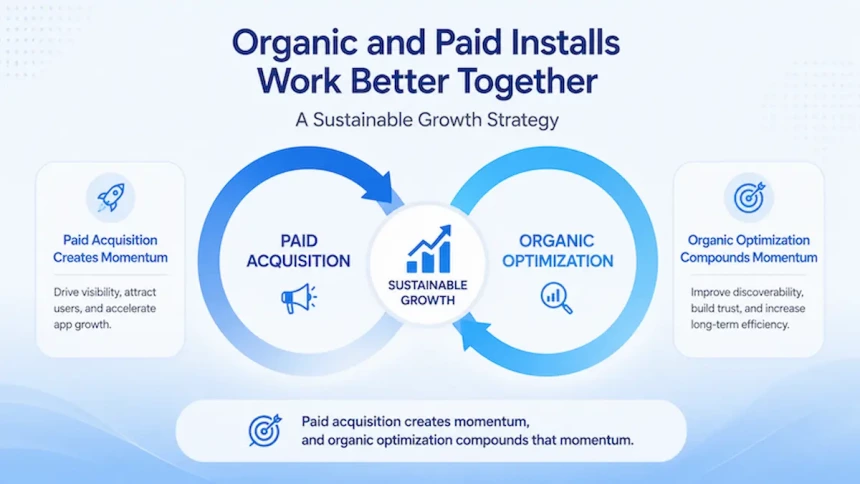
Paid campaigns bring users to the app store, while ASO helps convert those visitors into installs. Optimized keywords, clear messaging, strong screenshots, and positive ratings improve store conversion rates, install efficiency, and return on ad spend.
Organic visibility also strengthens paid performance. When users already recognize and trust an app through search, recommendations, or brand awareness, they are more likely to engage with paid campaigns. This can increase conversion rates, reduce acquisition costs, and decrease long-term dependence on paid channels.
By combining organic growth, ASO, and paid acquisition, apps can build a more efficient and sustainable growth strategy.
Paid Acquisition as a Growth Accelerator
Paid installs provide the speed and scale that organic channels cannot deliver immediately. For new apps, paid campaigns create early visibility and help teams test audiences, validate demand, and identify effective messaging before organic growth develops.
Creating a Positive Growth Feedback Loop
When organic and paid channels are optimized together, they can create a self-reinforcing growth cycle.
1. Paid campaigns create initial visibility
Paid advertising introduces the app to new audiences and generates early demand.
2. User activity creates stronger market signals
More installs, engagement, ratings, and reviews provide additional signals that support app store performance.
3. Organic visibility improves
As awareness increases and store performance improves, more users discover the app through search rankings, recommendations, category visibility, and brand searches. This effect isn’t always immediate: a user may see an ad, not install right away, and later search for the app by name and install it organically.
This path — Paid exposure → Brand awareness → App search → Organic install — means some “organic” installs are actually downstream effects of paid spend, and shouldn’t be counted as if paid played no role.
4. Stronger conversion improves paid efficiency
A better-performing store listing allows paid traffic to convert more effectively, reducing acquisition costs and improving campaign profitability.
The goal of this loop isn’t to maximize organic or paid installs on their own — it’s to maximize total growth. That means evaluating incremental installs, user quality, acquisition cost, lifetime value, and return on ad spend together, rather than judging each channel by its own isolated metrics.
How to Measure the Real Impact of Paid Installs
Paid installs are easy to count, but counting alone doesn’t show their true value — some of those users might have installed anyway without advertising. To know whether paid campaigns actually create new growth, you need to measure incrementality: the additional installs generated by paid campaigns, beyond users who would have installed organically.
Cannibalization is a common challenge in paid acquisition. Some users who click or view ads may have installed the app organically even without advertising. In one Adjust case study, Sleep Cycle found up to 50% cannibalization across some of its campaigns — evidence that attributed installs don’t always equal incremental growth. Without incrementality testing, teams can overestimate campaign impact and optimize toward installs that were not truly generated by ads.
The simplest check costs nothing. Pause your campaigns for a week or two and watch total installs. If installs barely move after accounting for seasonality and normal fluctuations, a large share of your paid traffic may not be incremental — those users would have found you anyway. If they drop sharply, the ads were doing real work.
For more precise answers, three methods dominate in digital advertising broadly — but for app install campaigns specifically, geo experiments are the main option, since Apple Search Ads and Google App Campaigns don’t support the other two.
Geo experiments. Split comparable regions into test and control markets. Change ad spend only in the test regions. The difference in outcomes is your incremental lift. Meta’s open-source GeoLift framework is a widely used implementation of this approach.
Two other methods — PSA tests (where the control group sees a placebo ad instead of your creative) and ghost ads (where the platform logs which control-group users would have seen your ad, without serving it) — offer more precise control over audience-selection bias. But both originate in web display advertising and aren’t available on Apple Search Ads or Google App Campaigns, so for app install marketers, geo experiments and pause tests remain the practical options.
How to Combine Organic and Paid Installs by App Stage
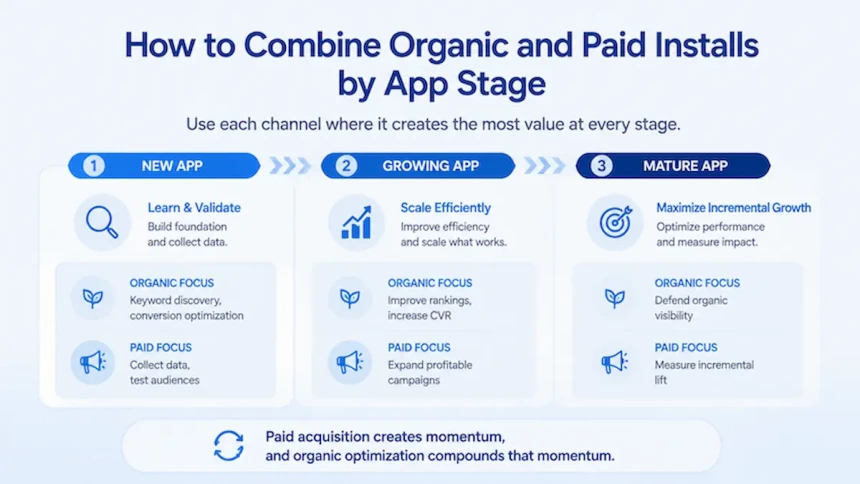
The right balance shifts as an app grows — the goal at each stage is to use each channel where it creates the most value, not to maximize one channel.
New Apps: Learn and Validate
With no rankings, reviews, or user data yet, organic growth takes time to develop. Priority: build a strong ASO foundation (keywords, messaging, screenshots) while using paid campaigns to accelerate learning.
Start with Exact Match campaigns on your highest-confidence keywords, then add a Discovery campaign — which uses Broad Match and Search Match, typically bid lower given its less proven intent — to mine new search terms you can move into your other campaigns. Full setup details are in Apple’s Discovery campaign guidance.
Pause or restructure keywords that generate significant traffic but consistently fail to convert, as this often indicates a mismatch between keyword intent and store messaging.
Growing Apps: Scale Efficiently
Signals of this stage: organic installs rising, initial ratings and reviews in place, keyword rankings improving, demand becoming predictable. Focus shifts from validation to efficient scaling.
A common practitioner rule for scaling paid budgets: increase spend by no more than 20% at a time, with at least 3-4 days between increases, to avoid resetting a platform’s delivery algorithm into a new learning phase — cited across independent Meta and Google Ads scaling guides, though it’s practitioner consensus rather than an official platform threshold.
Only scale once ROAS has been stable for two consecutive weeks at a level that clears your target margin — many teams use roughly 3x as a starting benchmark, but the right number depends heavily on category, price point, and monetization model; if CPA is already close to target, hold off rather than push further.
On the ASO side, this is the stage to formalize testing rather than eyeball it: Run screenshot and video variants through Google Play’s Store Listing Experiments or Apple’s Product Page Optimization (PPO). A 7–14 day test window is a useful starting point, but select a winner only after the experiment reaches sufficient sample size and statistical significance.
Mature Apps: Maximize Incremental Growth
By this stage, your app already ranks well, people recognize your brand, and you’ve got plenty of campaign data to work with. So the question isn’t “how do we grow” anymore — it’s “how do we spend smarter.”
A simple way to check your health at this stage is to look at LTV vs. CAC — basically, how much a user is worth to you over time compared to how much it costs to acquire them. A healthy LTV:CAC ratio is usually around 3:1, but consumer apps often run lower — closer to 2.5:1 — because higher churn compresses lifetime value. The right number still depends on your category, business model, and payback speed, per Chargebee’s LTV:CAC benchmark data.
At this stage, it’s worth revisiting the geo experiments covered earlier — run them periodically on your main channels to confirm spend is still generating incremental users, not just installs that would have happened anyway.
| Stage | Primary Goal | Organic Focus | Paid Focus |
| New App | Learn & validate | Keyword discovery, conversion optimization | Collect data, test audiences |
| Growing App | Scale efficiently | Improve rankings, increase CVR | Expand profitable campaigns |
| Mature App | Maximize incremental growth | Defend organic visibility | Measure incremental lift |
Best Practices for Combining Organic and Paid Growth
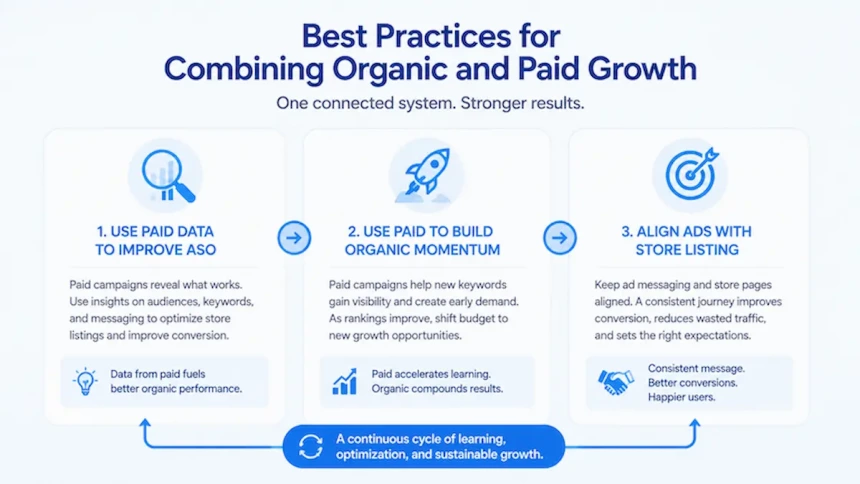
Turning the feedback loop above into a routine comes down to three habits:
First, align ads with the store listing. Paid ads and store pages should communicate the same value proposition. A consistent user journey from ad message to store listing improves conversion, reduces wasted traffic, and creates better user expectations after installation. Effective store listing optimization helps ensure that your metadata, creative assets, and user experience work together to improve app visibility and conversion.
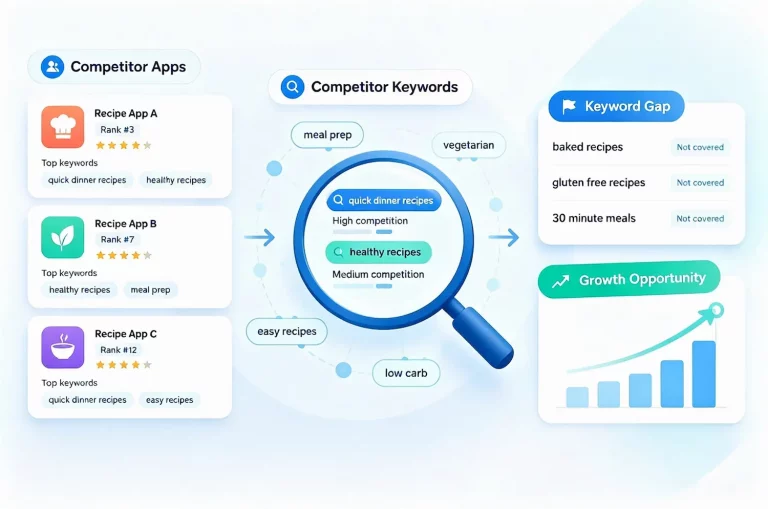
Next, feed paid data back into your store listing on a set cadence. Every 2-4 weeks, pull top-converting keywords and ad creatives from campaign reports and check whether your title, screenshots, and description still reflect them. Reviewing app store keywords competitors can help you understand competitor rankings, evaluate keyword difficulty, and identify potential keyword gaps.
Finally, set a concrete signal for shifting budget. When a paid-driven keyword starts ranking organically on its own (typically top 10 without paid support), test cutting spend on it and reallocating to new discovery keywords.
Organic and Paid Installs Work Better Together
Organic growth improves long-term visibility and acquisition efficiency; paid acquisition provides speed, scale, and market insight. Paid performance should be measured by incremental growth, not installs alone, to avoid paying for users who’d have converted organically anyway.
Before increasing paid spend, teams should check:
- Is the store listing optimized for conversion?
- Are paid campaigns generating incremental users?
- Are paid insights improving ASO decisions?
The takeaway from the feedback loop above: paid and organic aren’t competing for budget, they’re compounding each other’s results.