

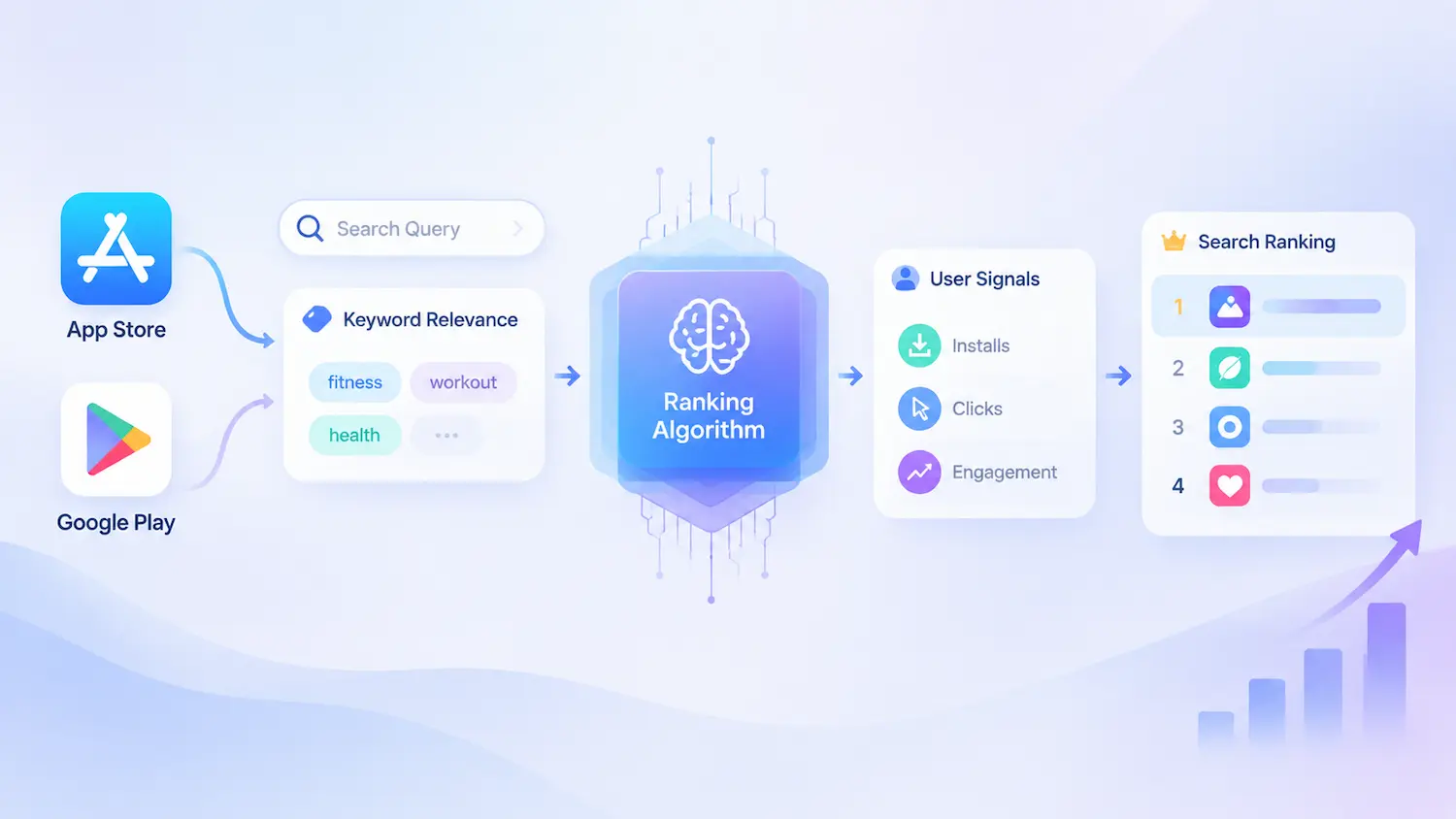
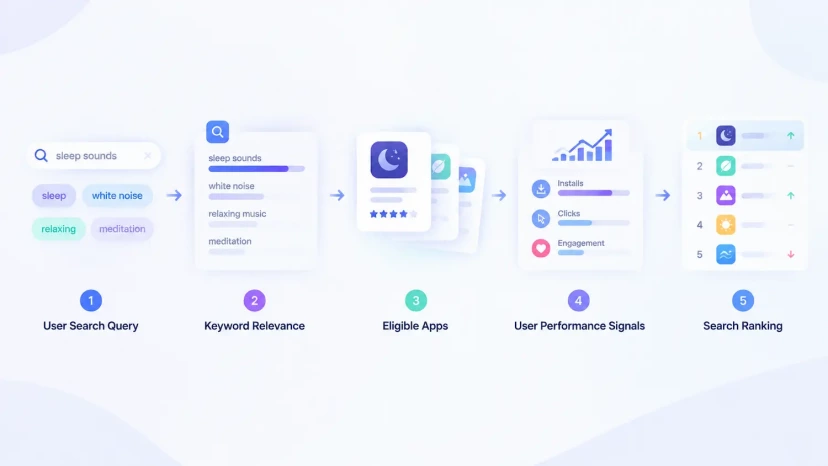
Both the App Store and Google Play rank apps by combining keyword relevance with user performance signals. Relevance helps an app enter the competition, while performance determines how visible it becomes.
Neither Apple nor Google has revealed the complete mechanics behind their ranking systems. This guide combines official App Store search documentation, research, and ASO observations to explain how App Store and Google Play evaluate keyword relevance, user behavior, and ranking performance.
As search remains one of the most important discovery channels on both stores, understanding keyword ranking algorithms is a critical part of following effective ASO best practices. This guide covers how ranking systems work, how App Store and Google Play differ, what changed in 2025–2026, and how to track and improve keyword performance effectively.
Key Takeaways
- Relevance gets apps into keyword competition.
- Performance signals drive ranking visibility.
- Apple and Google keep their algorithms undisclosed.
- Search remains a key discovery channel.
- Tracking reveals what improves keyword visibility.
What Is a Keyword Ranking Algorithm?
A keyword ranking algorithm determines where an app appears in search results by evaluating how relevant the app is to a search query and how users respond after discovering it. Ranking works in two stages.
Relevance is the qualification round: the algorithm decides whether an app is eligible to compete for a search term. Performance is the competition round: it determines how well the app ranks among other qualified apps, based on user responses such as clicks, installs, and engagement signals.
In practice, the App Store keyword ranking algorithm and Google Play’s ranking system share this two-stage structure, even though the technical implementation differs — as the next two sections explain.
Two technical details matter here. First, keyword matching can span multiple fields rather than one. An app named “Leafy” with “houseplant” in its Keyword Field and a Subtitle reading “Watering Guide” may still rank for “when to water indoor plants” — even though that exact phrase appears nowhere in the metadata. The system connects “Watering Guide” and “houseplant” to the same underlying intent.
Second, keyword rankings can vary by country. The same keyword may face different competition in the U.S. and German markets, so a term that ranks well in one country may perform differently in another. Local competition, user behavior, and market demand can all influence keyword visibility.
Keyword Ranking Algorithm Workflow: User Search Query → Keyword Relevance → Eligible Apps→ User Performance Signals→ Search Ranking
How the App Store Algorithm Ranks Keywords
Apple’s ranking system evaluates both app relevance and user response after discovery. Understanding this distinction helps explain why two apps targeting the same keyword can rank differently, even with similar metadata.
Relevance Signals: How Apple Connects Queries With Apps
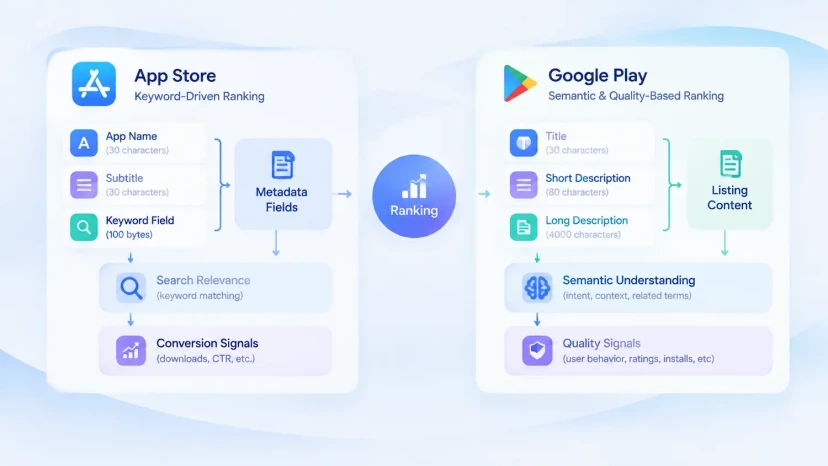
Apple evaluates relevance across several app information and discovery surfaces, including the App Name, Subtitle, Keyword Field, In-App Purchases, Events, and Custom Product Pages. Together, these signals help determine whether an app enters the competition for a given search term.
Apple evaluates relevance by considering whether an app matches the user’s search intent. An app can include a keyword in its metadata and still fail to qualify if the overall context does not align with what users are actually looking for.
Search Performance Signals: Why Conversion Matters
Once an app qualifies for a keyword, performance signals help determine how it ranks among competing apps. Apple considers how users respond after seeing an app in search results, including impressions, product page views, and installs.
Conversion from search — how often a search impression leads to a download — is widely considered an important performance indicator in App Store ranking discussions.
Personalization and Temporal Factors
Search rankings are not static or identical for every user. Apple’s system can factor in elements such as user location, prior search behavior, and changes in market demand over time.
Rankings can also fluctuate without any metadata changes, simply because competition, user interests, and keyword demand shift. Most ASO tracking tools display aggregated, non-personalized rankings, which provide useful direction but may not perfectly match what an individual user sees in live search results.
How Google Play Search Ranking Works in 2026
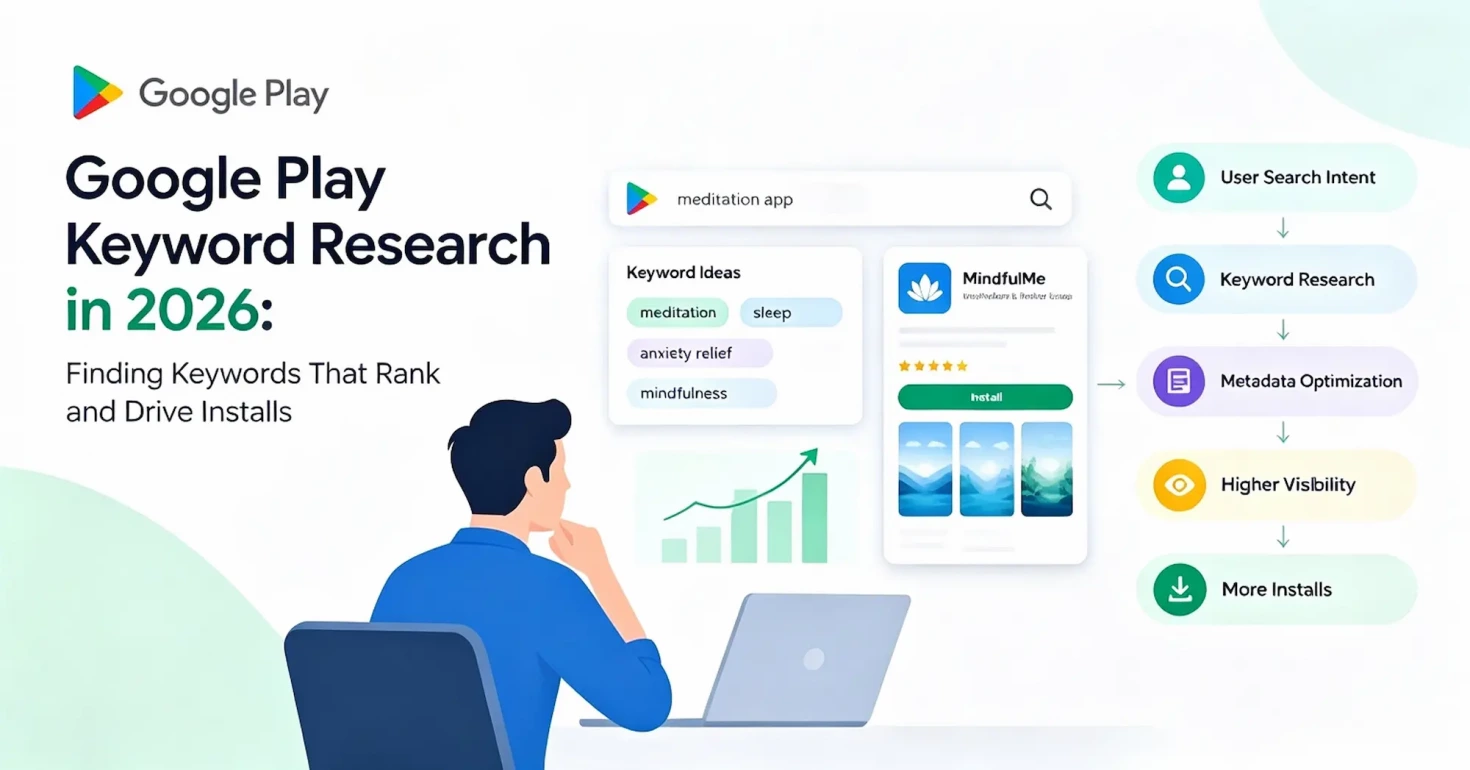
While the App Store uses dedicated keyword metadata fields, Google Play relies heavily on overall store listing content and semantic understanding to match apps with user search intent. Instead of only matching exact terms, selecting the right Google Play App Keywords helps apps better align with user queries and improve search relevance.
1. Text Relevance and Semantic Matching
Google Play analyzes text across the Title, Short Description, and Long Description using natural language processing to understand relationships between concepts. For example, an app focused on “relaxing sounds” may be relevant for searches related to sleep or relaxation because the underlying user intent overlaps.
2. Ranking Signals Beyond Keywords
Beyond listing relevance, Google Play also considers broader quality and engagement signals. These Google Play ranking factors include user engagement indicators, ratings, reviews, and app quality.
3. Android Quality Signals
Technical factors such as crash rate, ANR (Application Not Responding) rate, and other Android vitals metrics help measure app stability, which can influence overall visibility.
4. Review Text Understanding
User reviews reveal how people describe their problems and experiences in their own words. These real-world phrases can help ASO teams discover new keyword ideas and better understand user intent.
On-Metadata Factors You Can Control
Metadata is one of the few ranking areas developers can directly optimize. However, Apple and Google use different approaches: the App Store relies on specific keyword fields, while Google Play evaluates the overall store listing through semantic understanding.
iOS Metadata Optimization
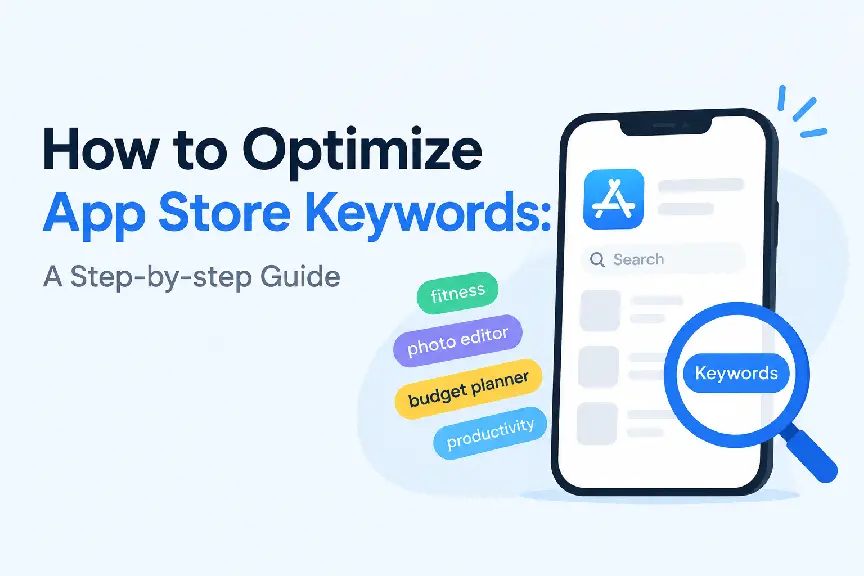
On the App Store, the main keyword-related fields are the App Name, Subtitle, and Keyword Field. Developers should avoid repeating terms already used in the App Name or Subtitle, since repetition wastes limited keyword space. In the Keyword Field specifically, Apple parses terms by comma — not by space — so “notes, planner, organizer” counts as three separate keywords, while “notes planner organizer” without commas may be read as one long string. Use commas to maximize the number of distinct terms the field can cover.
Android Metadata Optimization
Google Play evaluates relevance across the Title, Short Description, and Long Description. Instead of repeating exact keywords, developers should create natural descriptions that clearly explain the app’s purpose and match user intent.
App Store vs. Google Play Metadata
| Factor | App Store | Google Play |
| Title | Important | Important |
| Subtitle | Important | Not applicable |
| Keyword Field | Yes | Not applicable |
| Description Content | Limited search role | Important for relevance |
| Semantic Understanding | Used | Strong emphasis |
| Technical Quality Signals | Present | Strongly emphasized |
User Behavior Factors After Installation
Search-stage behavior alone doesn’t tell the full story. What happens after installation can also affect long-term app visibility and growth beyond immediate search-conversion signals.
Retention and User Quality Signals
Ranking systems appear to consider more than raw download volume. Whether users remain engaged after installation can provide a stronger indication that an app is satisfying user intent.
Retention benchmarks vary by category, so there is no single number that defines “good” retention across all apps. Strong retention can support long-term visibility because it suggests that users find the app valuable after installation.
Ratings, Reviews, and Review Activity
Average star rating alone does not show the complete picture. Review activity and recent sentiment can provide additional insight into user satisfaction and how an app is performing over time.
Detailed reviews can also reveal how users describe their problems and experiences, helping both developers and ASO teams better understand user needs and discover new optimization opportunities.
Update Quality and Market Competition
Not all updates create the same impact. Meaningful improvements, such as new features, bug fixes, and performance enhancements, usually create more user value than frequent minor updates.
At the same time, app rankings are always relative. Even if an app remains unchanged, competitors improving their metadata, conversion, and user experience can change the competitive landscape and influence search visibility.
What Changed in App Store Discovery and Ranking Signals in 2025–2026
Neither Apple nor Google has published a complete account of algorithm changes during this period. The following analysis combines official announcements, published research, and observations from ASO practitioners — not a full technical disclosure.
Screenshot Captions: An Emerging Discovery Signal
Some ASO practitioners have observed that screenshot captions may contribute to keyword relevance or conversion performance, although Apple has not publicly confirmed them as a direct ranking factor.
Current best practices focus on using captions to explain an app’s core value, highlight user benefits, and avoid simply repeating the Title or Subtitle.
Custom Product Pages and Organic Discovery
Apple has confirmed that Custom Product Pages can help developers create more targeted discovery experiences by allowing customized pages for different audiences and use cases. This enables apps to test different value propositions and better match specific user intents without changing the default product page.
Semantic Relevance and AI-Based Understanding
Recent AI-driven approaches suggest that App Store systems are increasingly using semantic understanding to assess search-query relevance. In a paper titled “Scaling Search Relevance: Augmenting App Store Ranking with LLM-Generated Judgments”, Apple researchers described using AI-generated relevance labels to evaluate this beyond exact keyword overlap.
A worldwide A/B test reported a statistically significant +0.24% increase in conversion rate after applying this approach, with the strongest gains observed on less common, long-tail queries — where semantic understanding can provide additional value.
This suggests that App Store ranking is increasingly combining semantic relevance with traditional keyword signals.
App Store Discovery Evolution 2025–2026
2025 — Increased focus on screenshot-based discovery optimization
↓
2025 — Expanded use of Custom Product Pages
↓
2026 — Stronger evidence of AI-assisted semantic understanding
How to Track and Interpret Keyword Ranking Changes
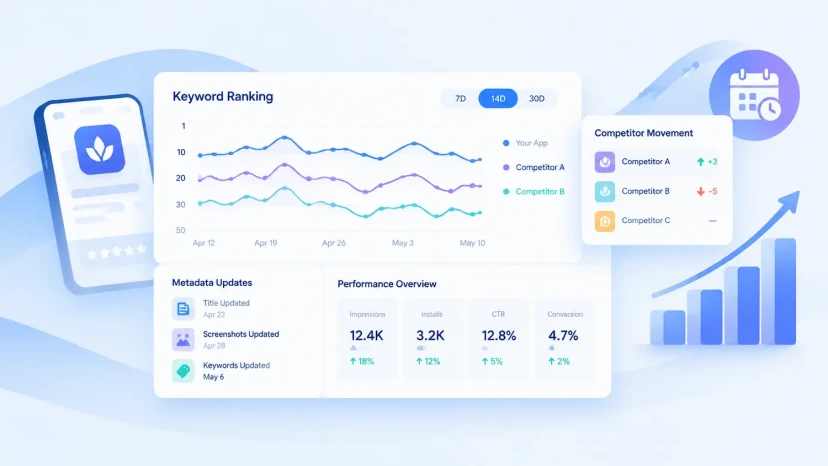
Because rankings shift for the reasons outlined above, effective tracking isn’t about reacting to every movement — it’s about identifying meaningful trends that guide better ASO decisions.
Setting Up Keyword Tracking
Effective tracking starts with identifying the right terms through App Store Keywords research, including brand keywords, core keywords, competitor keywords, and opportunity keywords. Each category serves a different purpose — brand keywords confirm baseline visibility, core keywords measure performance on primary growth terms, competitor keywords reveal relative positioning, and opportunity keywords identify potential growth areas.
Tracking frequency should match keyword importance. Core keywords deserve daily or near-daily tracking, especially in competitive categories. Broader, lower-priority keywords can be reviewed weekly, while monthly strategic reviews help identify long-term trends instead of reacting to daily fluctuations.
Five Keyword Ranking Fluctuation Patterns
Not all ranking movement means the same thing. Recognizing the pattern helps determine the right response:
- Stable ranking — Position remains consistent over time.
Action: Use it as a baseline and continue monitoring performance. - Gradual decline — Position decreases slowly over days or weeks, often due to increased competition, changing relevance signals, or shifts in user behavior.
Action: Review metadata and competitor positioning for possible gaps. - Sharp drop — Position falls suddenly.
Action: Investigate recent changes, including metadata updates, app releases, competitor movements, or changes in search relevance. - Volatile ranking — Position moves up and down within a short window with no single clear cause.
Action: Track over 2–3 weeks before drawing conclusions; short-term noise rarely warrants a metadata change. - Ranking without a clear metadata match — An app ranks for a term that does not appear explicitly in its listing.
Action: Consider whether semantic understanding or broader relevance signals may be connecting the app with that user intent.
How to Judge Ranking Changes
| Degree of Movement | Possible Explanation |
| Small movement | Normal day-to-day fluctuation |
| Medium movement | Competition changes or relevance shifts |
| Large movement | Significant visibility changes requiring investigation, such as possible algorithm changes, competitor updates, or metadata changes |
Avoid reacting to ranking changes immediately. Observing changes over a longer window can help distinguish temporary fluctuations from meaningful trends before making major metadata or strategy adjustments.
Caveat: Ranking data from third-party ASO tools is an estimate, not an official Apple or Google metric. Treat short-term movements as directional signals rather than definitive ranking changes.
Four Common Mistakes That Hurt Keyword Rankings
Even a well-researched keyword list can underperform if it is applied incorrectly. These mistakes are among the most common issues found in App Store and Google Play listings.
1. Writing Marketing Copy Without Search Intent
Phrases like “Easy to Use” or “Best App Ever” may sound persuasive, but they usually provide little keyword value because users rarely search for generic claims. Every searchable field should balance clear messaging with terms that reflect real user intent.
2. Repeating the Same Keywords Everywhere
Filling every available field with the same core keyword — for example, using “fitness tracker” in the App Name, Subtitle, and repeated across the Keyword Field — wastes limited space that could otherwise cover related search terms like “workout log” or “step counter.” On iOS especially, since the App Name and Subtitle already count toward relevance, repeating those same words in the 100-character Keyword Field usually adds little additional coverage and effectively shrinks the number of unique terms an app can compete for.
3. Ignoring Platform Differences
iOS uses a dedicated Keyword Field, while Google Play relies on overall store listing content, including the Title, Short Description, and Long Description. Applying the same keyword strategy across both platforms often means underusing iOS’s dedicated Keyword Field or leaving Google Play’s Long Description too thin to build topical relevance.
4. Set-and-Forget Optimization
Rankings shift as competitors update metadata, user behavior changes, and search systems evolve. Without ongoing tracking, a keyword strategy that worked at launch can gradually lose effectiveness.
Six Strategies to Improve Keyword Rankings
Improving keyword rankings is rarely the result of a single change. It usually comes from combining relevance, performance signals, and consistent monitoring over time.
1. Improve Metadata Relevance
Align the App Name, Subtitle, and Keyword Field (or Title and descriptions on Google Play) with the terms users actually search for. Cross-check candidate keywords against available ASO tool estimates for search demand and difficulty before committing them to limited metadata space, and re-validate relevance whenever a competitor’s ranking shifts significantly.
As covered earlier, semantic relevance is becoming increasingly important alongside traditional keyword matching — the goal is to help both users and search systems clearly understand what the app does.
2. Improve Acquisition and Conversion Performance
Ranking visibility alone does not guarantee growth. Analyze keyword-level conversion performance to identify whether users’ expectations match your store listing. If a keyword ranks well but generates fewer installs than expected, review screenshots, messaging, and product positioning before changing the keyword itself.
3. Test Conversion Assets
Icon, screenshots, and preview video influence whether visibility turns into installs. For high-value keywords, align screenshots and messaging with the specific user intent behind the search query. Strong rankings with weak conversion assets still underperform, so testing these elements should run alongside keyword optimization.
4. Improve Retention and User Satisfaction
As covered earlier, retention is a stronger quality signal than download volume alone. Since most drop-off happens in the first few days, prioritize the first-session experience — simplify onboarding, surface the app’s core value before asking for permissions or sign-up, and review session-drop points to find where users disengage early.
5. Use Events and Fresh Content
Regularly updating store events, seasonal content, or promotional updates creates additional opportunities to capture changing user demand beyond core metadata.
For example, seasonal campaigns can reveal emerging keyword opportunities. Analyze performance from these updates to identify secondary keywords that may deserve longer-term optimization.
6. Monitor Competitors
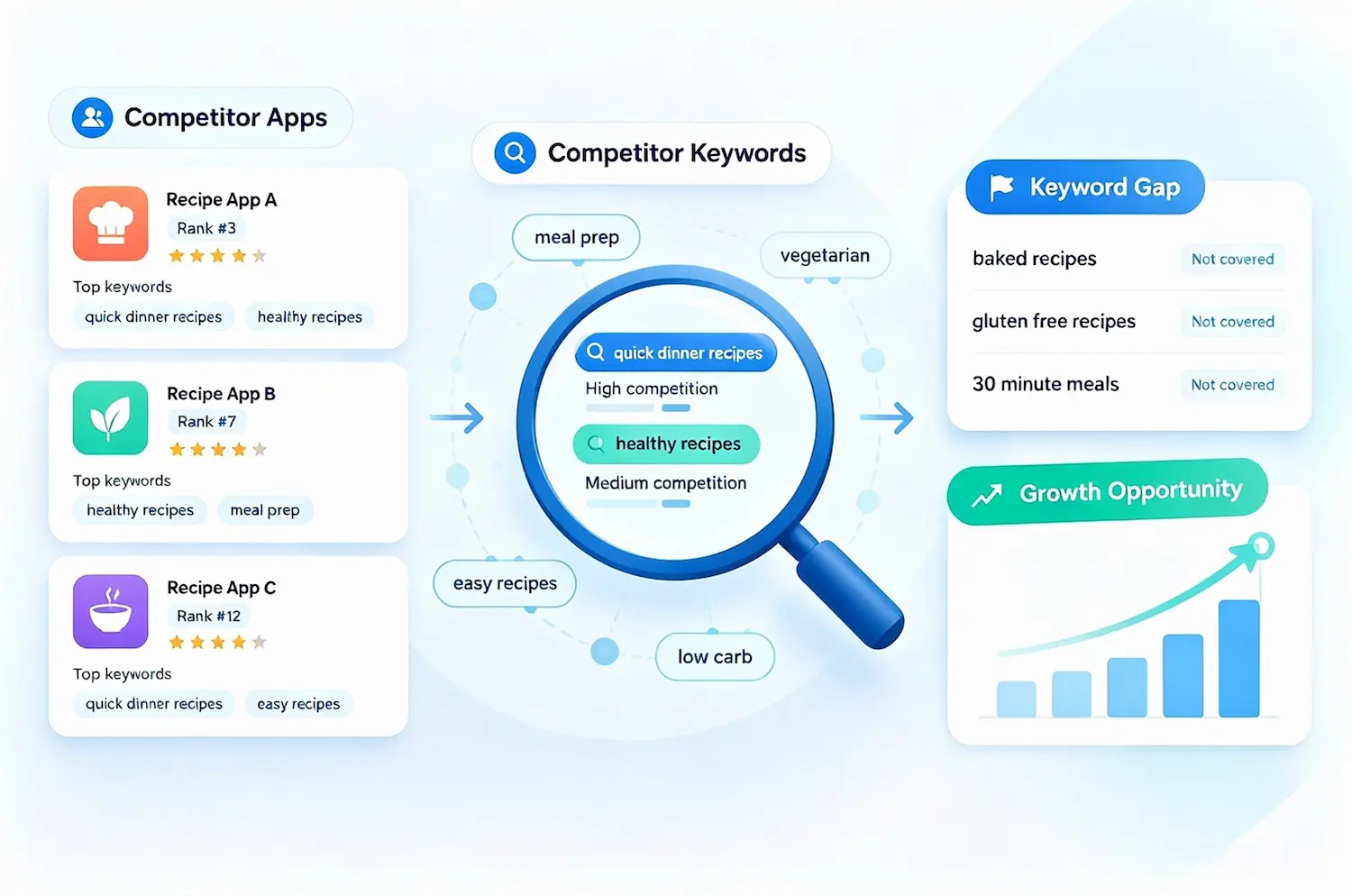
Ongoing competitor tracking helps identify keyword gaps, ranking changes, and new optimization opportunities. Monitor a focused group of direct competitors regularly and watch for meaningful changes, such as sudden ranking improvements or new keyword appearances in their listings and reviews.
These changes can reveal emerging trends or optimization strategies worth testing. After any metadata update, evaluate results across multiple time windows, such as 7, 14, and 30 days, rather than reacting to short-term ranking fluctuations.
Rankings Are a Signal, Not the Goal
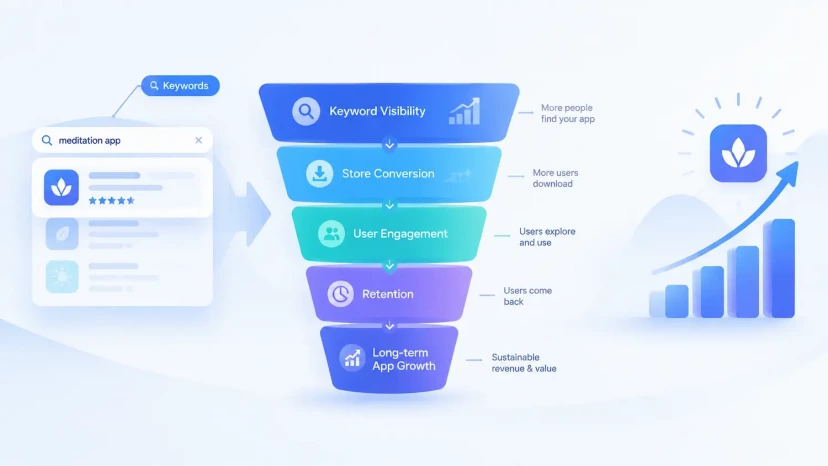
Keyword ranking optimization is an ongoing process rather than a one-time metadata update.
Search algorithms evaluate more than keyword matches. Relevance helps an app qualify for search results, while performance signals — including conversion, retention, engagement, and user satisfaction — influence how that visibility develops over time. Ranking systems are designed to identify apps that not only match a user’s query but also deliver a valuable experience after discovery.
A strong ASO strategy connects these signals together: choose keywords that reflect real user intent, optimize metadata and conversion assets that support discovery, and improve the product experience that keeps users engaged after installation.
Keyword rankings provide valuable feedback about how search systems interpret an app and how users respond to it. But long-term growth does not come from chasing positions alone — it comes from continuously improving the connection between what users search for, what the algorithm understands, and what the app delivers.