

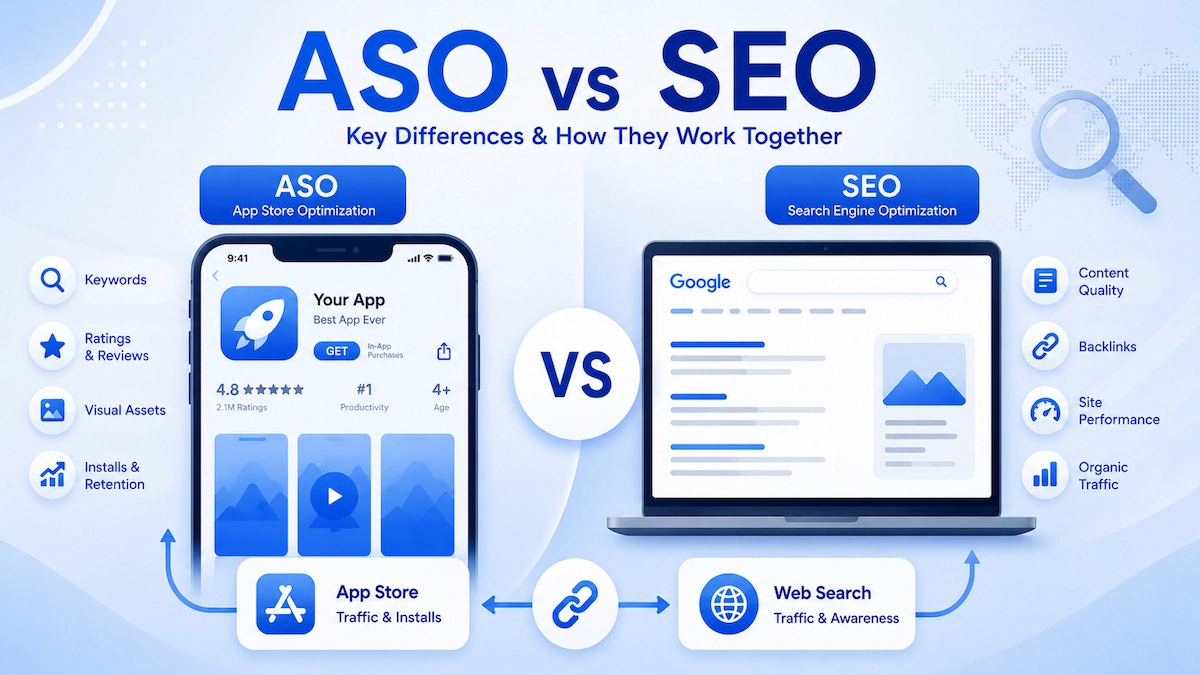
If you’ve spent any time in mobile marketing, you’ve probably heard ASO described as “SEO for apps” — a catchy but misleading comparison. SEO gets your website found on search engines like Google; ASO gets your app found inside app stores like the App Store and Google Play — different platforms, different ranking rules, different search intent.
Throughout this article, “SEO” specifically refers to SEO for an app’s own marketing website, not general website SEO for any business.
Treated as separate disciplines, though, ASO and SEO miss their real potential: web traffic can funnel users toward downloads, and insights from one channel can sharpen the other.
In this article, we’ll break down the key differences between ASO and SEO, clear up the naming confusion around them, and show how the two can work together to drive stronger, more sustainable app growth.
What Is ASO vs. SEO?
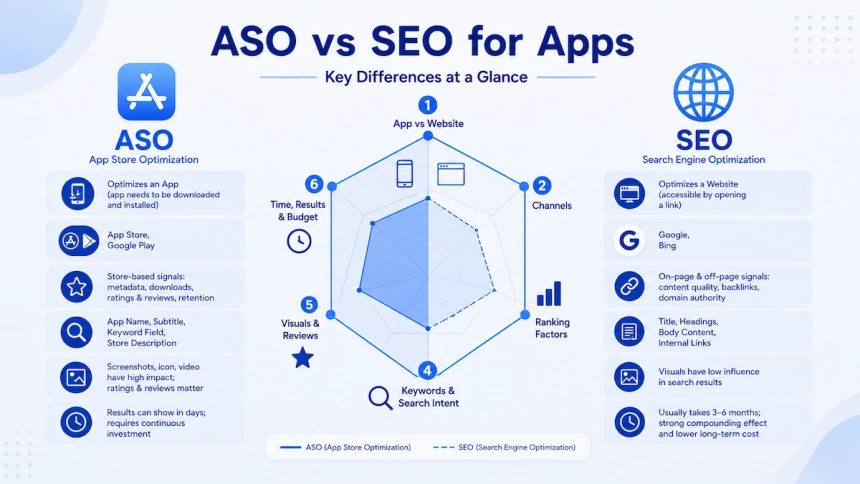
| Dimension | ASO (App Store Optimization) | SEO (Search Engine Optimization) |
| App vs Website | Optimizes an App — something that needs to be downloaded and installed to use | Optimizes a Website — something accessible by opening a link |
| Channels Compared | Traffic comes from the App Store, Google Play | Traffic comes from Google, Bing etc. |
| Ranking Factors and KPIs | Store metadata (title, subtitle/short description, keyword fields), downloads, ratings & reviews, retention; KPIs like keyword rankings and store page conversion rate | On-page content and external trust signals (content quality, backlinks, domain authority); KPIs like organic sessions, CTR, bounce rate |
| Keywords and Search Intent | Keyword research centers on App Name, Subtitle, Keyword Field, and store description | Keyword research centers on Title, Heading, body content, and internal links |
| Visuals and Reviews | Screenshots, icon, and preview video carry much greater weight; ratings & reviews are an off-page ranking factor and conversion trigger | Visual elements have low influence, since they don’t appear on all search engine results pages |
| Time to Results and Budget | Results sometimes visible within days, but requires continuous investment | Usually takes 3–6 months, but has a stronger compounding effect and more controllable long-term cost |
What Is App Store Optimization (ASO)?
App Store Optimization (ASO) is the process of improving an app’s visibility and conversion rate in app stores such as the App Store and Google Play. It involves optimizing app store elements, including keywords, metadata, visual assets, ratings, and reviews, to help apps reach more relevant users.
The goal of ASO is to increase organic installs by improving keyword rankings and encouraging more users to install an app after visiting its store page. A well-planned ASO strategy helps apps attract high-intent users and turn store visitors into downloads
What Is Search Engine Optimization (SEO)?
Search engine optimization (SEO) is an ongoing process. It optimizes a website’s content and structure. The goal is to rank higher in search engine results, like Google or Bing etc. Higher rankings bring in more organic traffic. This helps a site get found when users search for information, products, or services.
SEO relies on two main parts. On-page SEO covers things you control directly, like content, HTML structure, and site speed. Off-page SEO builds trust through backlinks and social signals. Rankings depend on hundreds of factors, so there’s no single fixed formula.
ASO vs SEO for Apps: Key Differences
While ASO and SEO share the goal of driving organic growth, they work in different ecosystems with different optimization methods. Let’s explore the key differences between ASO and SEO and how they impact app growth.
App vs Website
The key difference between ASO and SEO comes from what they optimize. ASO focuses on apps that aim to be discovered and downloaded by users, while SEO focuses on websites that users can access through a browser.
This difference in platforms affects their growth strategies, costs, and optimization processes. Websites can be built and updated quickly with tools like WordPress or Wix. Apps require development, platform adaptation, and regular updates.
Channels Compared
SEO and ASO focus on different discovery channels. SEO targets search engines like Google and Bing, while ASO targets app stores like the App Store and Google Play.
These platforms also create different optimization processes. Website changes can usually go live immediately. App updates need to pass Apple or Google’s review process before release.
The investment focus is also different. SEO requires ongoing content creation and link building. ASO relies more on creative assets, store page testing, and conversion optimization.
Ranking Factors and KPI
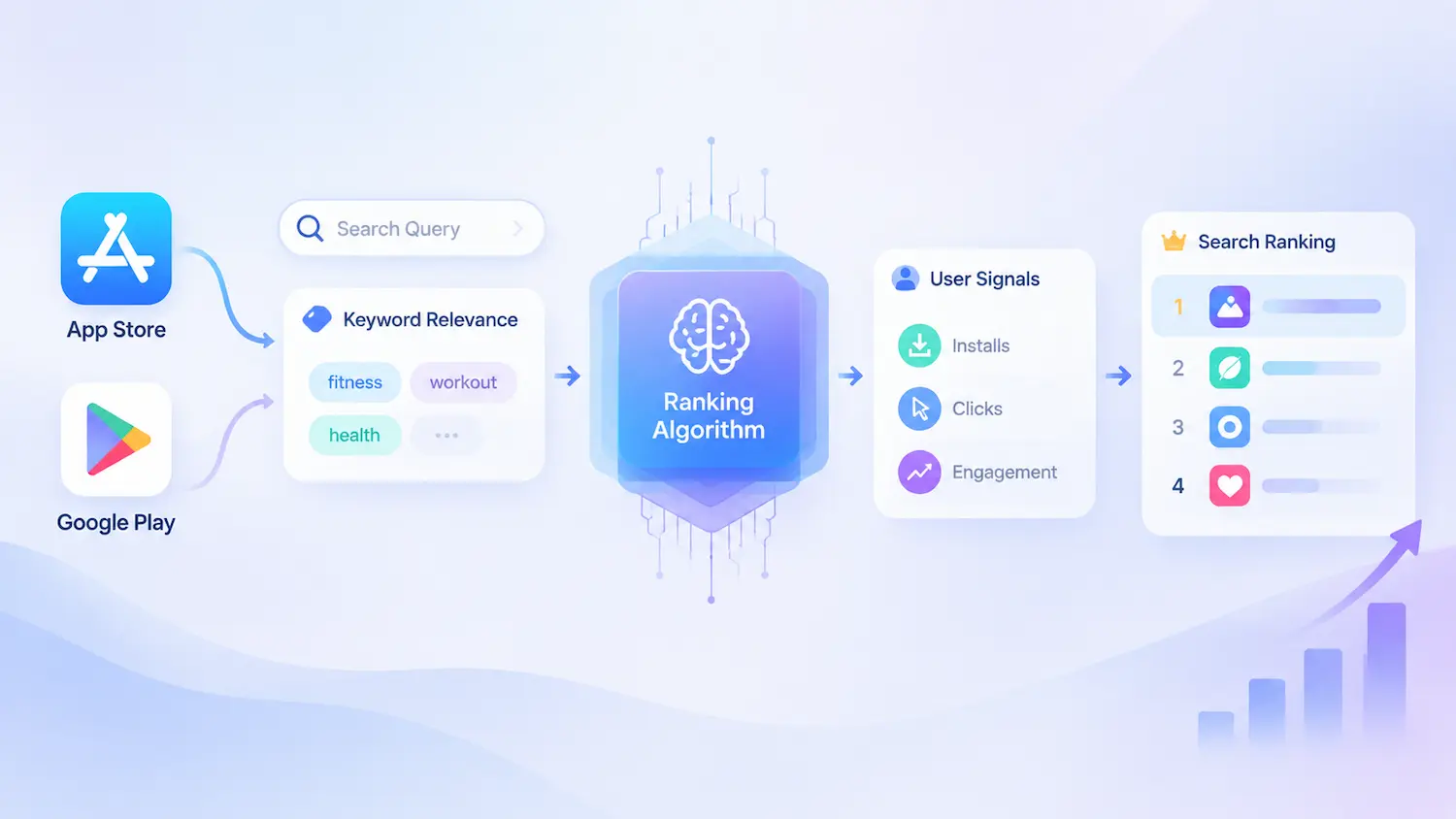
ASO and SEO have different ranking factors because they optimize for different platforms. ASO focuses on app store signals, while SEO focuses on website and search engine signals.
ASO rankings are mainly affected by app store signals, including title and keyword fields, downloads, ratings and reviews, and user retention. SEO rankings are mainly affected by web content and external trust signals, including content quality, the quantity and quality of backlinks, and domain authority.
The final business goal of both ASO and SEO is to increase app downloads, but their optimization metrics are different. ASO teams focus on keyword rankings, store page conversion rates, and search visibility to measure app store performance. SEO teams focus on organic sessions, click-through rate (CTR), bounce rate, and backlinks to measure search traffic and user engagement.
These KPIs reflect the results of different ranking factors. ASO measures how keyword relevance, store page quality, and user behavior improve app store performance. SEO measures how content quality, technical performance, and website authority improve search visibility.
Keywords and the Search Intent
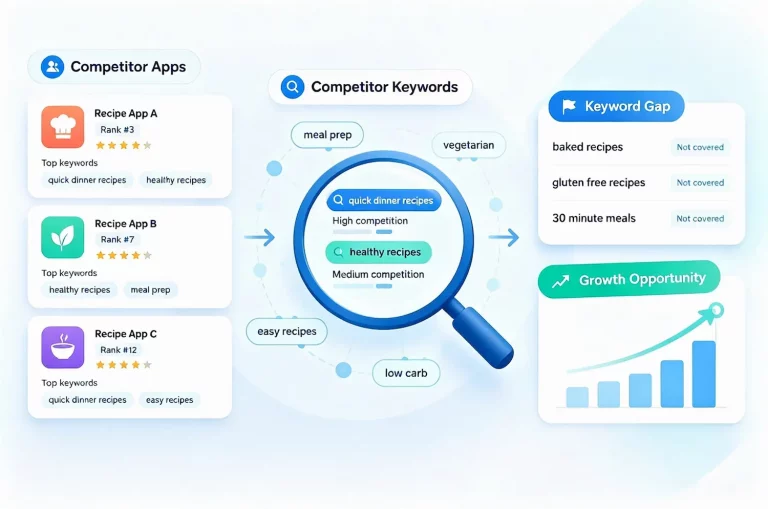
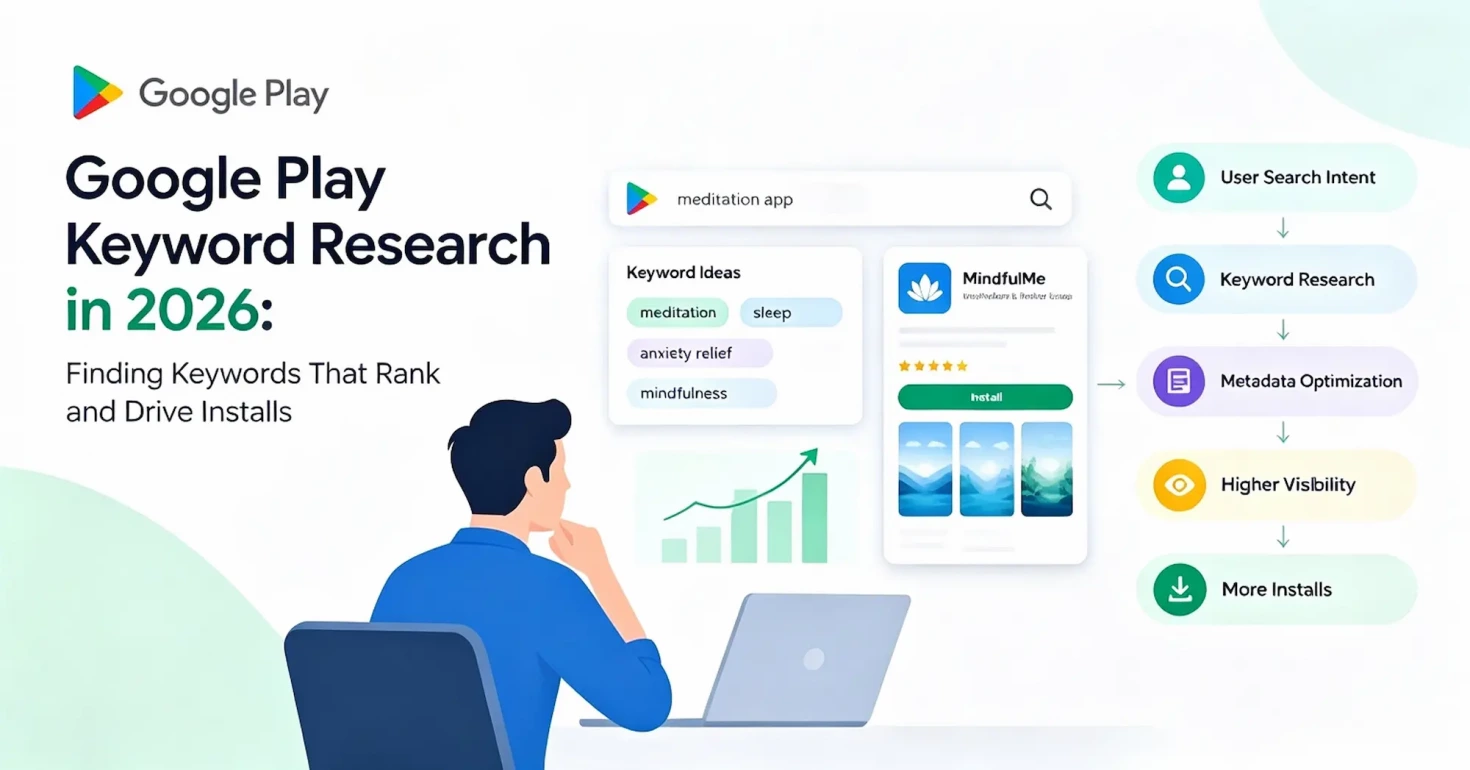
ASO keyword research centers on how app stores match search queries. It relies on metadata like the App Name, Subtitle, and the iOS Keyword Field, a hidden 100-character field, plus store descriptions. The focus is on functional terms, category terms, and highly relevant search terms. Because app stores offer limited space, ASO emphasizes packing this space efficiently, so every character works toward coverage and relevance.
SEO keyword research centers on webpage content and how search engines interpret it. Keywords typically appear naturally in the Title, Headings, body content, and internal links. Early SEO relied on explicit tags like meta keywords. But Google stopped treating these as core ranking factors due to abuse.
Today, SEO depends more on semantic understanding, content quality, and whether a page satisfies user intent — shifting keyword strategy from “setting keywords” to “covering topics and search intent.”
Despite these execution differences, user search intent behind ASO and SEO keywords is fundamentally the same. A user searching “language learning app” in the App Store wants the same thing as a user searching “best app to learn a language” in Google. Both are looking for a solution to the same problem. The real difference isn’t what users want. It’s how each channel understands and structures that intent into keywords.
This is why the same keyword strategy usually can’t be copied directly from one channel to the other. App stores and search engines use different matching mechanisms, different content space, and different ranking logic. ASO depends more on how keywords are arranged within limited metadata. SEO depends more on how well content covers complex search needs and topic relevance.
Visuals and Reviews
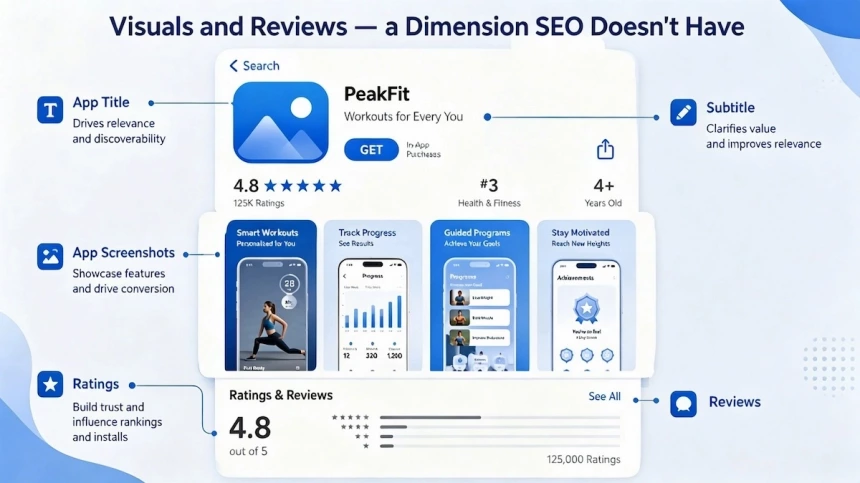
Visual assets play a much bigger role in ASO than in SEO.
App screenshots, icons, and preview videos directly influence how users evaluate an app. These elements appear on app store pages and affect download decisions. In SEO, visual elements usually have a smaller impact on rankings and conversions. They do not appear consistently across all search engine results pages.
Ratings and reviews are also important ASO ranking factors. They work as off-page signals that reflect user trust and app quality. In traditional SEO, ratings and reviews are mainly important for transactional websites, such as e-commerce platforms. They are less relevant for most informational websites. So managing app ratings and reviews is good for your app growth.
At the same time, reviews strongly influence conversion rates in app stores. Positive ratings and user feedback can encourage more users to install an app.
Together, these elements create a unique optimization dimension that exists in ASO but is limited in SEO.
Time to Results and Budget
ASO and SEO both require continuous optimization, but they differ in how quickly they deliver results and how investments are allocated.
ASO often produces results faster than SEO. In some cases, ranking improvements appear within a few days after metadata or creative assets are updated. This makes ASO suitable for apps that need faster organic growth.
However, ASO requires ongoing investment. Developers need to maintain ratings and reviews, test store assets, and often support growth with paid user acquisition campaigns. Stopping these efforts can reduce visibility over time.
SEO usually takes longer to show results. Most websites need three to six months before they gain stable organic traffic. Building authority, earning backlinks, and publishing quality content all require time.
The long-term return is different. Once a website ranks well, it can attract consistent traffic with lower ongoing costs. Strong content also continues to generate value over time. This creates a stronger compounding effect than ASO in most cases.
As a result, ASO is generally better for achieving faster results, while SEO is often more cost-effective for long-term organic growth.
What ASO and SEO Have in Common
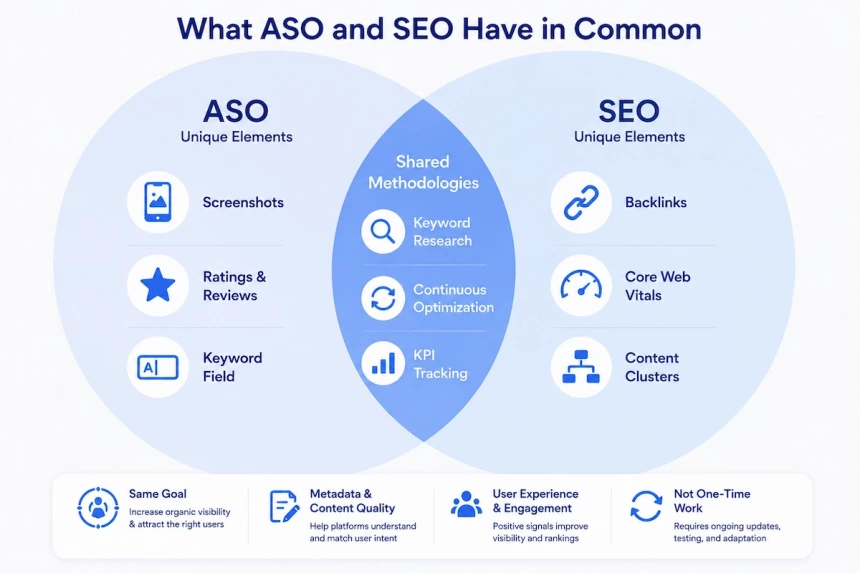
Although ASO and SEO target different platforms, they follow many of the same optimization principles. Both aim to increase organic visibility and attract users who are actively searching for a solution. The overall methodology is similar, but the execution is different.
First, both ASO and SEO rely on keyword research to improve visibility. Understanding how users search is the foundation of every optimization strategy. Second, neither ASO nor SEO is a one-time task. Both require continuous testing, regular updates, and ongoing optimization as user behavior and algorithms change.
Both also rely on dedicated KPIs to measure performance. Tracking the right metrics helps teams evaluate results and identify new optimization opportunities.
Another similarity is the importance of metadata and content quality. Well-optimized metadata improves discoverability, while high-quality content helps search engines and app stores understand what users are looking for.
Finally, both ASO and SEO are influenced by user experience and engagement. Positive user signals can strengthen visibility and support better ranking performance over time.
The methodology behind ASO and SEO is similar. However, the way these principles are applied is very different.
App Store Optimization vs App Store SEO: Same Thing, or a Misnomer?
Many people use App Store SEO and App Store Optimization (ASO) interchangeably. However, the two terms are not viewed the same way by the ASO industry. This section explains where the label comes from and why many professionals avoid using it.
Where the Label Comes From
If you search for “App Store SEO”, you will often find content about App Store Optimization (ASO). In most cases, App Store SEO is simply another name for ASO. Some people also use terms such as Mobile App SEO.
The label became popular because it helps explain ASO to people who already understand SEO. Both practices focus on improving organic visibility through search. Using the term App Store SEO makes it easier to describe ASO as the app store equivalent of search engine optimization.
However, ASO is the more accurate and widely accepted industry term. It specifically refers to optimizing an app’s visibility and conversion performance in app stores, while App Store SEO is mainly an informal label used for comparison.
Why the Industry Pushes Back on the Label
Although the term App Store SEO is widely used, many ASO professionals avoid it because it does not accurately describe how app stores work.
The App Store and Google Play are merchandising platforms rather than traditional search engines. Their goal is not only to match search queries. They also surface apps that users are more likely to install and use.
A mobile app can rank for thousands of keywords at the same time. By contrast, a web page usually focuses on a smaller group of related topics and keywords. Search behavior is also different. App store users usually search for brands, app categories, or specific features. Google users often search for information, answers, or comparisons before taking action.
For this reason, many ASO experts prefer the term ASO instead of App Store SEO. They believe the two disciplines share similar ideas, but they operate under fundamentally different discovery systems.
App vs Website First for User Acquisition: A Startup’s Decision Framework
Match the Strategy to Your Business Model
Should app companies focus on ASO or SEO? Choosing between ASO and SEO starts with understanding where your product creates value and how users discover it. The best strategy is to focus on the channel that supports your core business and customer journey.
If your app is the main product, ASO should come first. This is common when the app is the core product, such as shopping apps, productivity tools, finance apps, or mobile games. The goal is to improve app visibility, increase store conversion, and boost app installs and downloads..
If your website is the main business asset, SEO should be the priority. This is common for blogs, media websites, SaaS companies, and content-driven businesses. SEO helps attract users through search engines and supports long-term traffic growth.
The test is simple: if a user’s journey ends with “open the App Store and install,” ASO owns that moment. If it ends with “read a page and take an action,” SEO owns it. Some products sit in between — a SaaS company with a companion mobile app, for example — and in that case, the primary acquisition channel usually still points to wherever the core value is delivered first.
App vs Website First When Budget Is Limited
When budgets are limited, startups need to prioritize the channel that can deliver the best return with available resources.
SEO usually requires consistent investment in content creation, technical optimization, and authority building. It is a long-term strategy that can generate sustainable organic traffic, but results often take months to develop.
ASO usually requires fewer resources to get started. Startups can improve visibility through metadata optimization, creative testing, and conversion improvements. However, faster app growth often requires additional investment in paid user acquisition and user retention.
For bootstrapped startups, the best choice depends on the available resources and growth goals. Companies with limited budgets can start with organic channels and scale gradually. Startups with funding and a mobile-first product can invest more aggressively in ASO and paid acquisition to accelerate growth.
How ASO and SEO Work Together
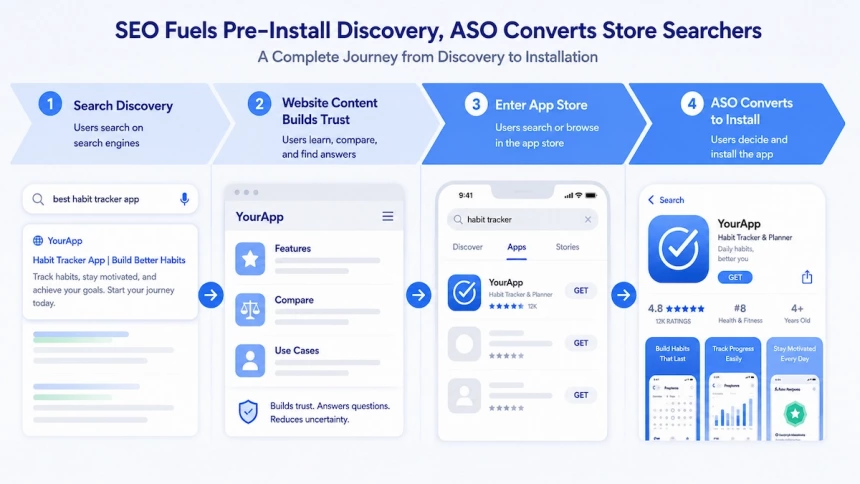
SEO Expands Discovery Before App Installation
SEO and ASO influence different stages of the user journey. While ASO helps apps get discovered inside app stores, SEO reaches users earlier when they are researching solutions, comparing apps, or looking for specific features.
SEO captures users during the research phase, while social channels increasingly influence early awareness. Users may first discover an app through platforms like TikTok, YouTube, or online communities. They then use search engines to learn more, compare options, and decide whether to install it.
Many users discover apps outside app stores. They may search Google, watch reviews, or read comparison articles before deciding which app to install. SEO helps apps appear during this research stage and creates additional opportunities to influence download decisions.
Website content can also build trust before installation. Feature pages explain what the app can do. Comparison pages help users understand how the app differs from competitors. Use-case pages show how the app solves specific user problems. These pages answer user questions and reduce uncertainty before users decide to download.
By supporting pre-install discovery, SEO creates additional touchpoints outside the app store. It helps bring qualified users to the app and works together with ASO to improve the full acquisition journey.
ASO Converts Store Searchers
While SEO helps users discover an app before installation, ASO focuses on converting users when they are already searching inside the app store.
App Store search remains one of the most important discovery channels for mobile apps. Apple has stated that search is a primary way users discover apps, and app visibility in search results depends on factors such as metadata relevance, downloads, ratings, and reviews.
Apple and third-party analytics firms haven’t published a fresh App Store-wide breakdown of discovery channels in recent years, but the core dynamic hasn’t changed — most ASO practitioners still treat search as the primary channel worth optimizing for.
ASO helps capture this high-intent traffic by improving keyword relevance, product page conversion, and user trust. Optimized titles, subtitles, screenshots, app previews, and ratings help users quickly understand the app and make a download decision.
SEO may bring users to the app ecosystem, but ASO determines whether those users convert after they reach the store. Together, they create a complete acquisition path from discovery to installation.
Localization and Shared Messaging
ASO and SEO share the same foundation: understanding how users search and what language they use to describe their needs. Both channels can benefit from a consistent keyword strategy and brand message across different markets. However, localization requires more than direct translation. Each market has different search behaviors, user expectations, and keyword preferences.
For both SEO and ASO, teams should conduct separate keyword research for each target market. A keyword that performs well in one country may not have the same meaning or demand in another region. Local users may also use different terms to describe the same problem or feature. Adapting keywords based on local search behavior helps improve visibility and relevance.
The same principle applies to brand messaging. Websites have more space to explain product value through detailed pages, comparison content, and use cases. App store listings have limited space, so the message needs to be more direct. Screenshots, titles, subtitles, and descriptions should quickly communicate the strongest reasons to download.
By aligning localization and messaging across both channels, SEO can educate users before installation, while ASO can reinforce the decision inside the app store. Together, they create a more consistent user journey from discovery to download.
Common Mistakes When Mixing ASO and SEO
ASO and SEO can support the same user journey, but they should not be treated as the same channel. Many teams make the mistake of applying SEO strategies directly to app store optimization. This often leads to weak store experiences and missed conversion opportunities.
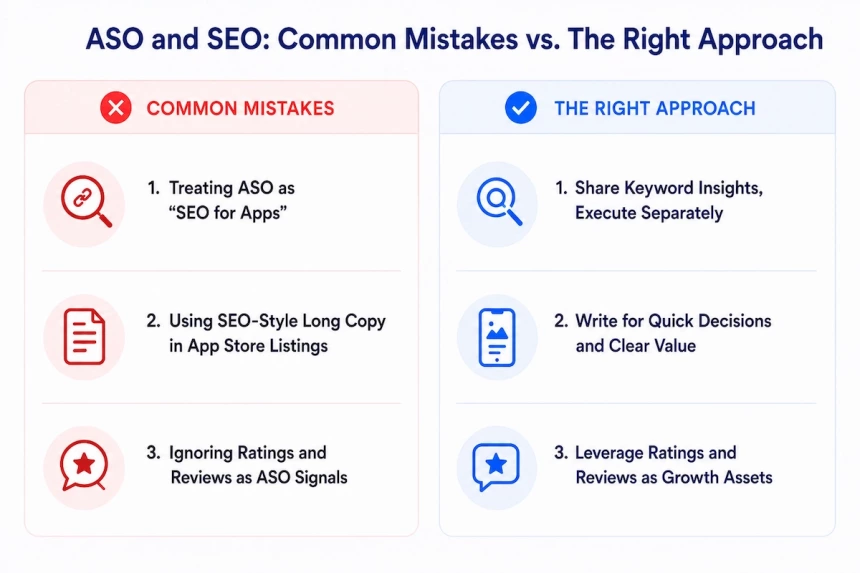
Treating ASO as “SEO for Apps”
One of the most common mistakes is viewing ASO as a smaller version of SEO. Both channels involve keyword research, but they optimize for different environments and user behaviors.
SEO focuses on helping users discover information through search engines. ASO focuses on helping users find and install apps inside app stores. App store performance depends not only on keywords but also on conversion assets such as screenshots, ratings, reviews, and product page messaging.
Teams that only focus on keyword placement may improve visibility but still lose potential users during the install decision. A strong ASO strategy needs to balance search relevance with conversion optimization.
A better approach is to treat SEO and ASO keyword research as shared intelligence, not copy-and-paste work. Website search queries reveal how users describe their needs.
However, app store keywords should be selected and organized according to ASO best practices.
In other words, insights can be shared, but execution should remain separate.
Ultimately, conversions depend on more than keywords. Screenshots, ratings, and reviews often have a greater impact on whether users install an app.
Using SEO-Style Long Copy in App Store Listings
Another common mistake is bringing the writing style of web content into app store pages. Website content can use detailed explanations, comparisons, and educational sections because users often need more context before making a decision.
App store listings have a different purpose. Users usually scan the page quickly and look for clear reasons to install. Long descriptions should support the conversion process instead of becoming a collection of repeated keywords or feature lists.
Keyword stuffing and overly complex messaging can make the listing less focused. The best store copy communicates the app’s value quickly and works together with screenshots and other visual assets.
Think about how people browse the App Store. How many users spend several seconds reading an app description? The answer is usually very few. The goal of app store copy is not to explain everything but to persuade users to tap the Install button. Keywords should appear naturally where they belong, while detailed feature explanations are better delivered through screenshots and preview videos.
This is one of the biggest differences between app store copy and website content.
Ignoring Ratings and Reviews as ASO Signals
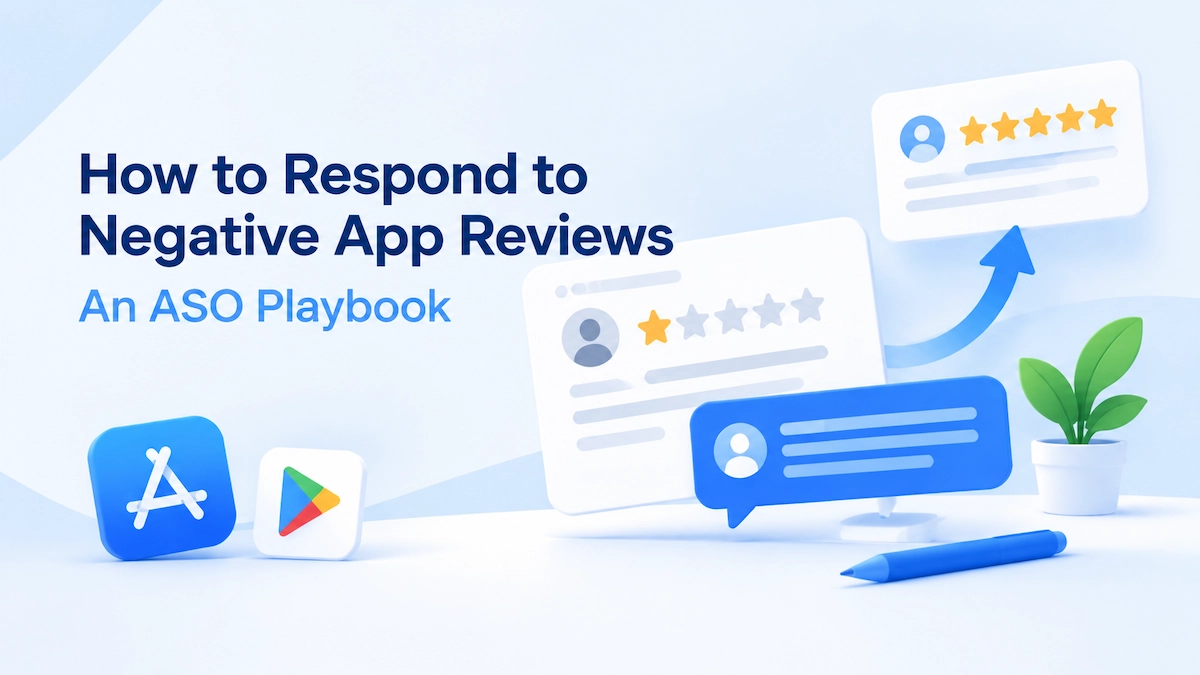
Some teams treat reviews and ratings as a customer support issue rather than part of ASO. However, reviews influence how users perceive an app before installation. They also provide valuable feedback about product experience, feature expectations, and common user concerns.
A strong keyword strategy cannot fully compensate for poor user trust. If ratings decline or negative review themes continue, conversion performance may suffer even when visibility improves.
For example, imagine an app with a strong feature set. If its rating drops from 4.5 to 3.8, the store page conversion rate will often decline, even if its keyword rankings stay the same. Users usually check the star rating and the latest reviews before deciding whether to install. Instead of treating reviews as a customer support task, use them as free user research.
Repeated praise highlights what users value, while recurring complaints reveal what needs improvement. These insights often provide better direction for future optimization than keyword reports alone.
SEO Essentials for Your App’s Website
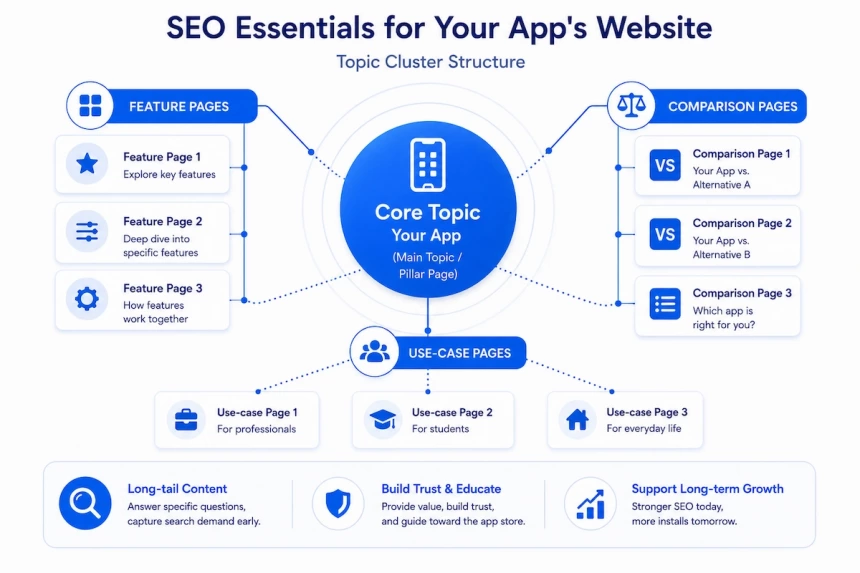
Keyword-Rich Content and Topic Clusters
SEO for an app website is not only about targeting individual keywords. It requires building topic clusters around core user needs and app use cases. By creating related content around one main topic, websites can cover different search intents and improve organic visibility.
A strong topic cluster should include different content types, such as feature pages, comparison pages, and use-case pages. Feature pages explain what the app can do. Comparison pages help users evaluate alternatives. Use-case pages show how the app solves specific problems in real situations.
Long-tail content can capture users with specific questions before they are ready to install. By answering these searches, the website can educate users, build trust, and guide them toward the app store. A well-structured content strategy helps SEO support long-term app acquisition.
Technical SEO and Core Web Vitals
Technical SEO ensures that an app website can be easily accessed, crawled, and used by visitors. Key factors include mobile-friendly design, fast page loading, secure browsing, and optimized images. Core Web Vitals measure user experience through loading performance, responsiveness, and visual stability. Improving these elements helps create a better website experience and supports SEO performance.
Backlinks and Brand Authority
Off-page SEO focuses on signals that come from outside the website. Among these signals, backlinks remain one of the most important factors for building website authority and improving search visibility. High-quality links from relevant and trusted websites can help search engines understand that the app website is credible and valuable.
For app businesses, one effective way to earn backlinks is through industry coverage and third-party reviews. For example, being featured in articles such as “best productivity apps” or “top apps for specific use cases” can generate valuable links while also increasing brand awareness. These mentions can introduce the app to new audiences before they visit the app store.
A strong backlink strategy should focus on quality rather than quantity. Links from relevant industry websites, media publications, and trusted review platforms are more valuable than random mentions. Combined with useful content, backlinks can strengthen SEO performance and support long-term app discovery.
Conclusion
ASO and SEO were never meant to be interchangeable — and, as this article has shown, they were never meant to be rivals either. ASO wins the app store; SEO wins the open web. Different platforms, different ranking signals, different content formats, but the same underlying goal: helping the right users find an app and decide to download it.
Treated as separate silos, each channel caps its own growth. SEO builds awareness and trust before the app store visit. ASO converts that intent into installs. Together, they create stronger, more sustainable app growth.
Above all, resist the urge to treat ASO as simply “SEO for apps.” App store search and Google Search use different keyword logic, content formats, ranking signals, and search behaviors. Keep them distinct, keep them coordinated, and each channel will make the other work harder.